McDonnell Douglas
F-15 STOL/MTD
First flight 7 September 1988 Retired 15 August 1991


McDonnell Douglas
F-15 STOL/MTD
|
|||||||||||||||||||||||||||||
.jpg)
.
History McDonnell Douglas
F-15 STOL/MTD
First flight 7 September 1988 Retired 15 August 1991
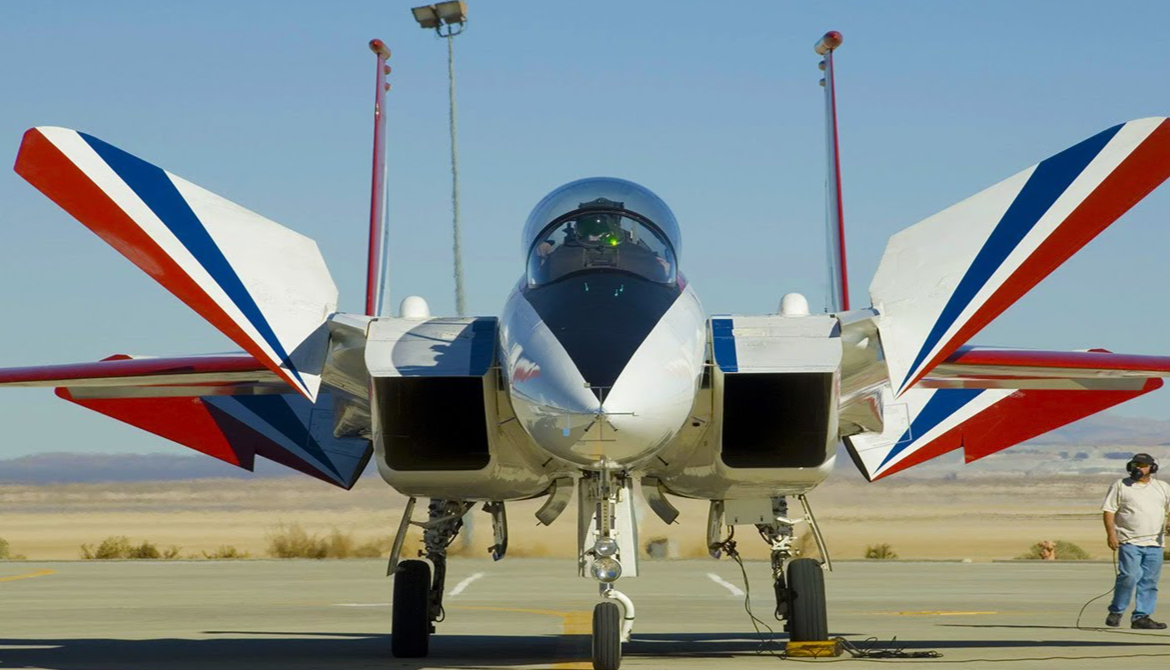
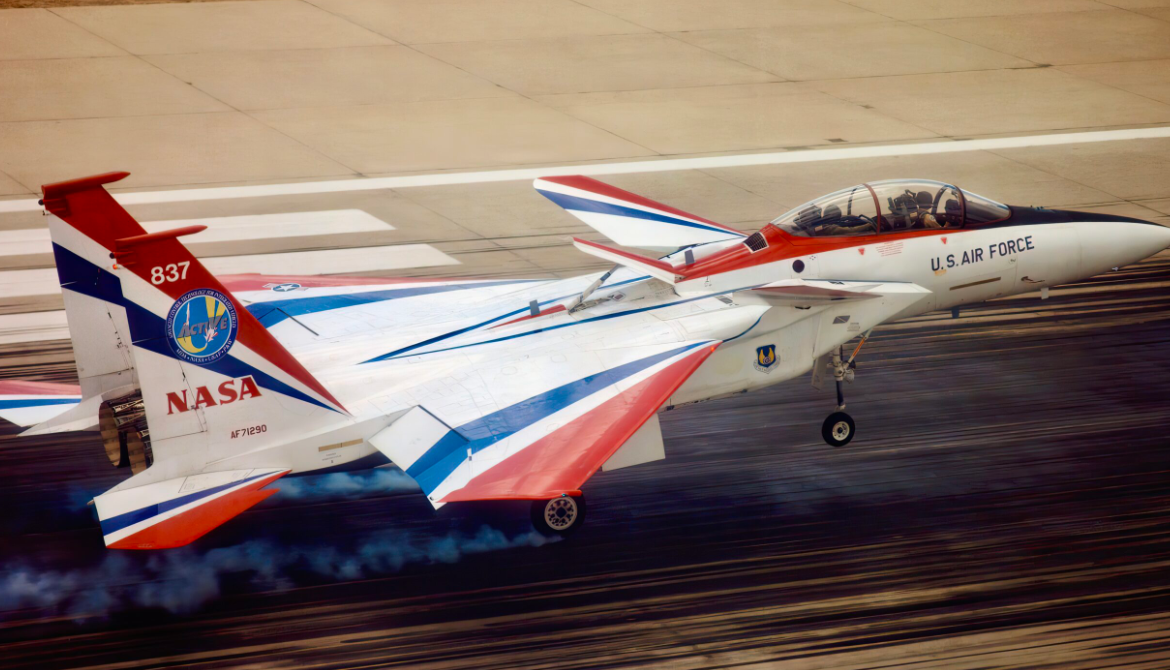
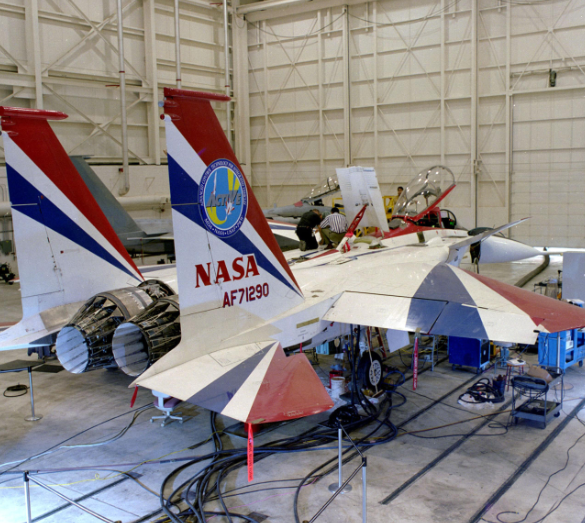
The McDonnell Douglas F-15 STOL/MTD (Short Takeoff and Landing/Maneuver Technology Demonstrator) is a modified F-15 Eagle. Developed as a technology demonstrator, the F-15 STOL/MTD carried out research for studying the effects of thrust vectoring and enhanced maneuverability. The aircraft used for the project was pre-production TF-15A (F-15B) No. 1 (USAF S/N 71-0290), the first two-seat F-15 Eagle built by McDonnell Douglas (out of 2 prototypes), the sixth F-15 off the assembly line, and was the oldest F-15 flying up to its retirement. It was also used as the avionics testbed for the F-15E Strike Eagle program. The plane was on loan to NASA from the United States Air Force.
This same aircraft would later be used in the F-15 ACTIVE ("Advanced Control Technology for Integrated Vehicles") from 1993 to 1999, and later in the Intelligent Flight Control System programs from 1999 to 2008.
While with NASA, the aircraft's tail number was 837. The aircraft is now on display at Edwards AFB
Design and development

In 1975, Langley Research Center began to conduct sponsored programs studying two-dimensional thrust vectoring nozzles; government and industry studies of non-axisymmetric two-dimensional (2-D) nozzles in the early 1970s had identified significant payoffs for thrust-vectoring 2-D nozzle concepts.
In 1977, Langley started a system integration study of thrust-vectoring, thrust-reversing, and 2-D nozzles on the F-15 with McDonnell Douglas. In 1984, the Flight Dynamics Laboratory, the Air Force Aeronautical Systems Division awarded a contract to McDonnell Douglas for an advanced development STOL/MTD experimental aircraft.
Operational history
Prior to 15 August 1991, when McDonnell Douglas ended its program after accomplishing their flight objectives, the F-15 STOL/MTD plane achieved some impressive performance results:
- Demonstrated vectored takeoffs with rotation at speeds as low as 42 mph (68 km/h)
- A 25-percent reduction in takeoff roll
- Landing on just 1,650 ft (500 m) of runway compared to 7,500 ft (2,300 m) for the standard F-15
0
KmCeiling
0
KmRange
0
MachAircraft Speed
0
Max Crew
Photo Gallery
McDonnell Douglas
F-15 STOL/MTD
First flight 7 September 1988



McDonnell Douglas
F-15 STOL/MTD
First flight 7 September 1988
General characteristics
- Crew: 2
- Capacity: 17,000 lb (7,112 kg)
- Length: 63 ft 8 in (19.42 m) excluding flight test nose boom
- Wingspan: 42 ft 10 in (13 m)
- Height: 18 ft 6 in (5.64 m)
- Wing area: 608 sq ft (56.5 m2)
Powerplant
- Empty weight: 35,000 lb (15,876 kg)
- Gross weight: 47,000 lb (21,319 kg)
- Horizontal tail span: 28.2 ft (8.60 m)
- Canard span: 25.6 ft (7.80 m)
- Powerplant: 2 × Pratt & Whitney F100-PW-229 turbofan engines, equipped with 20° three-dimensional thrust vectoring P/YBBN, 17,800 lbf (79 kN) thrust each dry, 29,000 lbf (130 kN) with afterburner

Specifications
- Maximum speed: 1,320 mph (2,120 km/h, 1,150 kn)
- Maximum speed: Mach 2.0
- Service ceiling: 60,000 ft (18,288 m)
Links to Youtube & Others
The Eagle can be armed with combinations of four different air-to-air weapons: AIM-7F/M Sparrow missiles or AIM-120 AMRAAM advanced medium-range air-to-air missiles on its lower fuselage corners.

McDonnell Douglas
F-15 STOL/MTD
The F-15 was shown to be capable of controlled flight with only one wing after an Israeli F-15D suffered a mid-air collision
Youtube Link
The F-15 was shown to be capable of controlled flight with only one wing after an Israeli F-15D suffered a mid-air collision

Read more in Boeing Aviation
.svg.png)