
JSC Kamov Design Bureau
Kamov Ka-50 Black Shark NATO reporting name 'Hokum-A'


JSC Kamov Design
Ka-50'Black Shark '
|
|||||||||||||||||||||||||||

|
|
|---|
.
History JSC Kamov Design Bureau
Kamov Ka-50 Black Shark. NATO reporting name 'Hokum-A'
-
Design

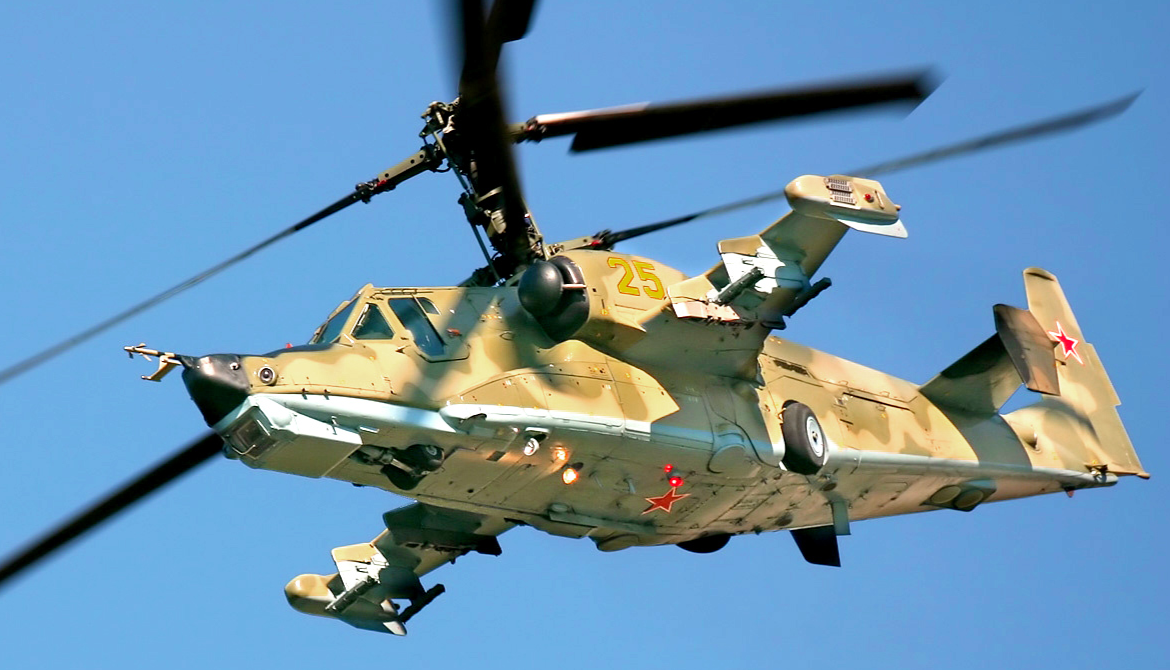
Kamov Ka-50 "Black Shark" on display Characteristics
During the late 1990s, Kamov and Israel Aerospace Industries developed a tandem-seat cockpit version, the Kamov Ka-50-2 "Erdogan" (Russian: Эрдоган, Turkish: Erdoğan), to compete in Turkey's attack helicopter competition. Kamov also designed another two-seat variant, the Kamov Ka-52 "Alligator" (Russian: Аллигатор, NATO reporting name: Hokum B). The Ka-52's unit cost is US$16 million as of 2023.
Military
For improved pilot survivability the Ka-50 is fitted with a NPP Zvezda (transl. Star) K-37-800 ejection seat, which is a rare feature for a helicopter. Before the rocket in the ejection seat deploys, the rotor blades are blown away by explosive charges in the rotor disc and the canopy is jettisoned.
Kamov Ka-50 "Black Shark" on display Following initial flight testing and system tests, the Council ordered the first batch of helicopters in 1990. The attack helicopter was first described publicly as the "Ka-50" in March 1992 at a symposium in the United Kingdom. The helicopter was unveiled at the Mosaeroshow '92 at Zhukovskiy in August 1992. The following month, the second production example made its foreign debut at the Farnborough Airshow, where it was displayed with an image of a werewolf on its rudder—gaining the popular nickname "Werewolf". The fifth prototype, painted black, played the title role in the movie Чёрная акула (Black Shark), which made the Ka-50 known by its current nickname.

0
KmCeiling
0
KmMAX RANGE
0
Km.hAircraft Speed
0
Max Crew
Photo Gallery
JSC Kamov Design Bureau
Ka-50 Black Shark. NATO reporting name 'Hokum-A'


JSC Kamov Design Bureau
Ka-50 Black Shark. NATO reporting name 'Hokum-A'
General characteristics
- Crew: 1
- Length: 16 m (52 ft 6 in)
- Height: 4.93 m (16 ft 2 in)
- Empty weight: 7,700 kg (16,976 lb)
- Gross weight: 9,800 kg (21,605 lb)
- Max takeoff weight: 10,800 kg (23,810 lb)
-
Powerplant
- Powerplant: 2 × Klimov VK-2500 turboshaft engines, (2,400 shp) each
- Main rotor diameter: 2 × 14.5 m
- Main rotor area: 330.3 m2 (3,555 sq ft) contra-rotating 3-bladed main rotors

Specifications
- Maximum speed: 315 km/h
- Cruise speed: 270 km/h
- Never exceed speed: 350 km/h
- Range: 545 km (339 mi, 294 nmi)
- Combat range: 470 km
- Ferry range: 1,160 km
- Service ceiling: 5,500 m
Armament
-
-
-
- Guns: 1 × mobile semi-rigid 30 mm Shipunov 2A42 cannon (460 rounds total, dual feeding AP or HE-Frag)
- Hardpoints: 6 × under-wing hardpoints, plus 2 on wingtips for countermeasures or air-to-air missiles with a capacity of 2,000 kg,
-
-
-
-
Links to Youtube & Others
Ka-32s are used for construction of transmission towers for overhead power lines, as it has somewhat higher lift capacity than the Vertol 107. In Canada, the Ka-32 is used for selective logging as it is able to lift selective species vertically

Kamov Design Bureau
Kamov Ka-50 Hokum-A
The Z-19 can primarily conduct attack, armed reconnaissance and scout missions. It is capable of destroying enemy tanks and other land-based targets.

Youtube Link
The helicopter has a length of 12m and height of approximately 4.01m. Maximum take-off weight is 4,500kg, whereas the empty weight is 2,350kg.

Read more in Russian Aviation
.
.png)
.png)