Lewis gun (or Lewis
automatic machine gun
or Lewis automatic rifle)
In service 1913–1942


Lewis gun Lewis automatic machine gun
| Lewis gun | |
|---|---|
 |
|
| Type | Light machine gun |
| Place of origin | United States (design) United Kingdom |
| Service history | |
| In service | 1914–1953 |
| Used by | See § Users |
| Wars | List of conflicts |
| Production history | |
| Designer |
|
| Designed | 1911 |
| Manufacturer | |
| Unit cost | £62 in 1918 |
| Produced | 1913–1942 |
| No. built | 152,050 in World War II 50,000 chambered in .30-06 |
| Variants | See § Variants |
|
|||||
|---|---|---|---|---|---|
.
History Lewis gun (or Lewis automatic machine gun
or Lewis automatic rifle)
In service 1913–1942
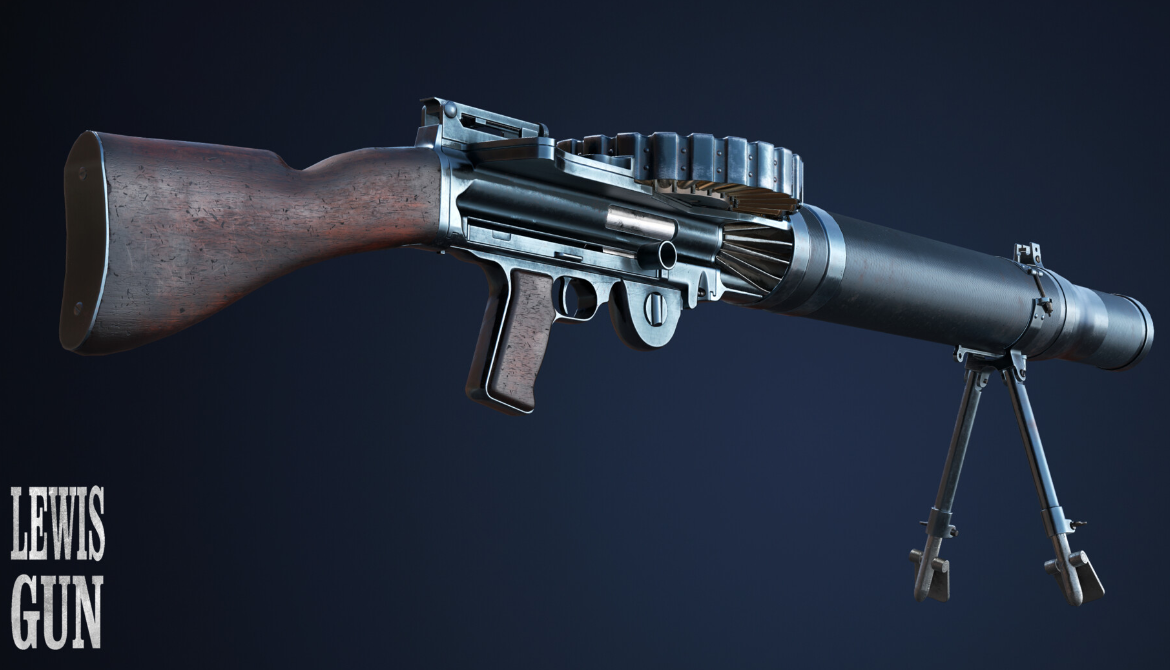
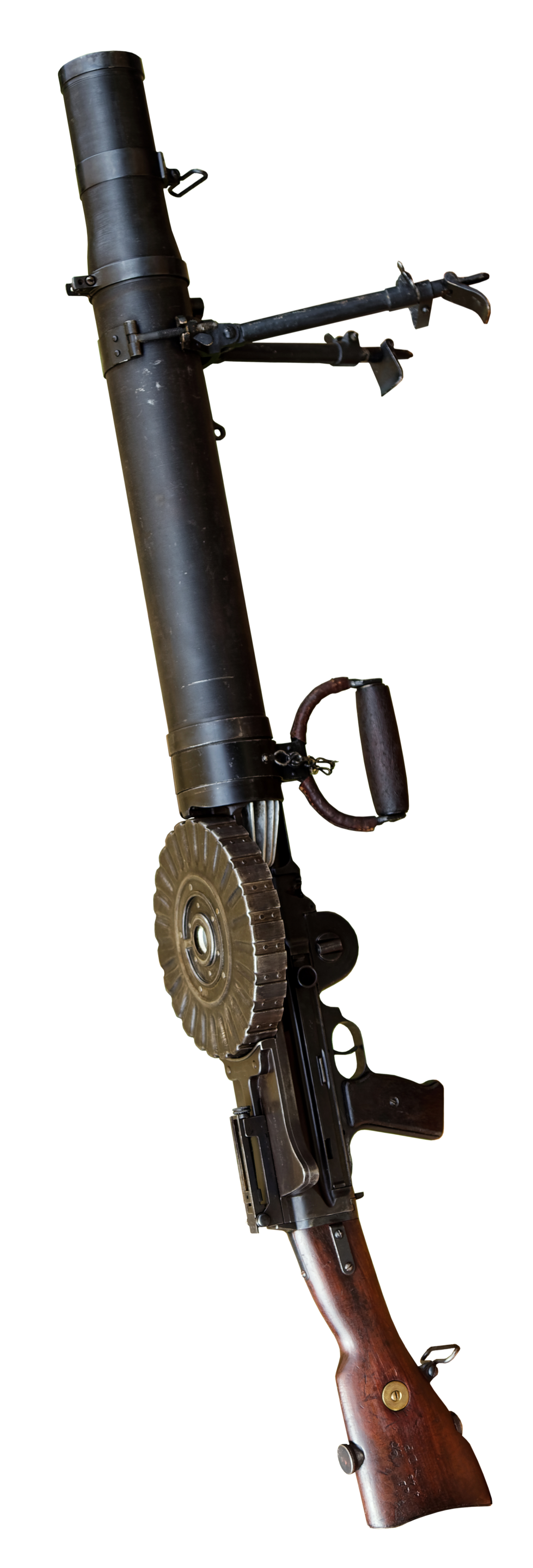
The Lewis gun (or Lewis automatic machine gun or Lewis automatic rifle) is a First World War–era light machine gun. Designed privately in the United States though not adopted there, the design was finalised and mass-produced in the United Kingdom, and widely used by troops of the British Empire during the war. It had a distinctive barrel cooling shroud (containing a finned breech-to-muzzle aluminium heat sink to cool the gun barrel), and top-mounted pan magazine. The Lewis served until the end of the Korean War, and was widely used as an aircraft machine gun during both World Wars, almost always with the cooling shroud removed, as air flow during flight offered sufficient cooling.
Design details
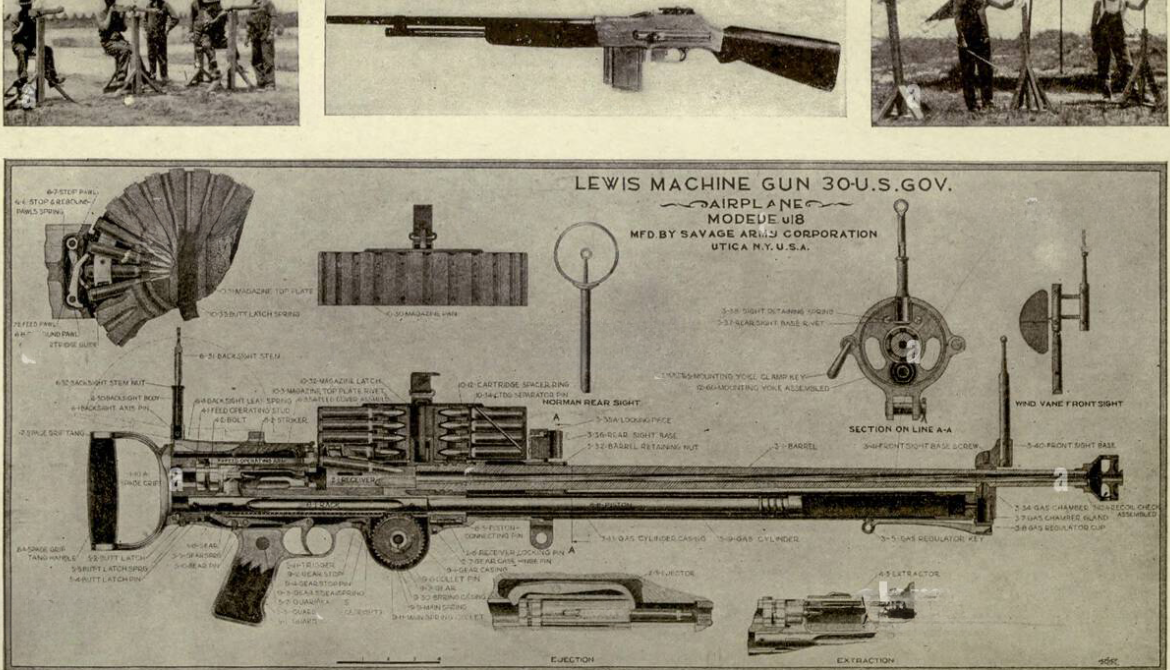
The Lewis gun was gas operated. A portion of the expanding propellant gas was tapped off from the barrel, driving a piston to the rear against a spring. The piston was fitted with a vertical post at its rear which rode in a helical cam track in the bolt, rotating it at the end of its travel nearest the breech. This allowed the three locking lugs at the rear of the bolt to engage in recesses in the gun's body to lock it into place. The post also carried a fixed firing pin, which protruded through an aperture in the front of the bolt, firing the next round at the foremost part of the piston's travel.

The gun's aluminium barrel-shroud caused the muzzle blast to draw air over the barrel and cool it, due to the muzzle-to-breech, radially finned aluminium heat sink within the shroud's barrel, and protruding behind the shroud's aft end, running lengthwise in contact with the gun barrel (somewhat like the later American M1917/18 Marlin-Rockwell machine gun's similar gun barrel cooling design)[18] from the "bottleneck" near the shroud's muzzle end and protruding externally behind the shroud's rear end. Some discussion occurred over whether the shroud was necessary: in the Second World War, many old aircraft guns that did not have the tubing were issued to anti-aircraft units of the British Home Guard and to British airfields,
mm
cartridge Caliber
Km
Effective Range
Kg
Gun Weight
Introduction
Introduction
Photo Gallery
Lewis gun (or Lewis automatic machine gun or
Lewis automatic rifle)
In service 1913–1942



Lewis gun (or Lewis automatic machine gun or
Lewis automatic rifle)
In service 1913–1942
-
-
-
-
Lewis gun Lewis automatic machine gun

Type Light machine gun Place of origin United States (design)
United KingdomService history In service 1914–1953 Wars List of conflicts Production history Designer - Samuel McClean
- Isaac Newton Lewis
Designed 1911 Manufacturer Unit cost £62 in 1918 Produced 1913–1942 No. built 152,050 in World War II
50,000 chambered in .30-06Variants See § Variants
-
-
-
Specifications Mass 28 lb (13 kg) Length 50.5 in (1,283 mm) Barrel length 26.5 in (673 mm) Width 4.5 in (114 mm)
Cartridge Action Gas-operated long stroke gas piston, rotating open bolt Rate of fire 500–600 rounds/min Muzzle velocity 2,440 ft/s (744 m/s) Effective firing range 880 yd (805 m) Maximum firing range 3,500 yd (3,200 m) Feed system 47- or 97-round pan magazine Sights Blade and tangent leaf -
In service 1913–1942
Links to Youtube & Others
On 3 May 2025, the head of the Ukrainian Main Directorate of Intelligence (HUR), lieutenant general Kyrylo Budanov claimed that three MAGURA V7 naval drones armed with AIM-9 Sidewinders modified for surface-to-air operation shot down two Russian Su-30 fighter jets in the Black Sea.[72][73] The Russian Defense Ministry did not comment, but Russian sources report that the pilots of one fighter were rescued by a cargo ship, whose crew received an award

Lewis gun Lewis automatic machine gun
On 2 November 2023, Israeli Air Force claimed one of its F-35I have shot down an unidentified cruise missile,

Youtube Link
Naval Air Weapons Station China Lake experimented with Sidewinders in the air-to-ground mode including use as an anti-tank weapon
Read more in Hughes Electronics
AIM-9X Sidewinder is a SRAAM
In service 1956–present
.png)