McDonnell Douglas
Boeing Defense, Space & Security
AGM-84 Harpoon
over-the-horizon, anti-ship missile
In service 1977–present


McDonnell/Douglas
AGM-84 Harpoon
 |
|
| Type | Anti-ship missile |
|---|---|
| Place of origin | United States |
| Service history | |
| In service | 1977–present |
| Used by | See operators |
| Wars | Iran–Iraq War Russo-Ukrainian War |
| Production history | |
| Manufacturer | McDonnell Douglas Boeing Defense, Space & Security |
| Unit cost | US$1,406,812 for Harpoon Block II (2020) |
| No. built | 7,500 |
|
|||||
|---|---|---|---|---|---|
.
History McDonnell Douglas Boeing Defense, Space & Security
AGM-84 Harpoon
over-the-horizon, anti-ship missile
In service 1977–present

The Harpoon is an all-weather, over-the-horizon, anti-ship missile manufactured by McDonnell Douglas (now Boeing Defense, Space & Security). The AGM-84E Standoff Land Attack Missile (SLAM) and later AGM-84H/K SLAM-ER (Standoff Land Attack Missile – Expanded Response) are cruise missile variants.
The regular Harpoon uses active radar homing and flies just above the water to evade defenses. The missile can be launched from:
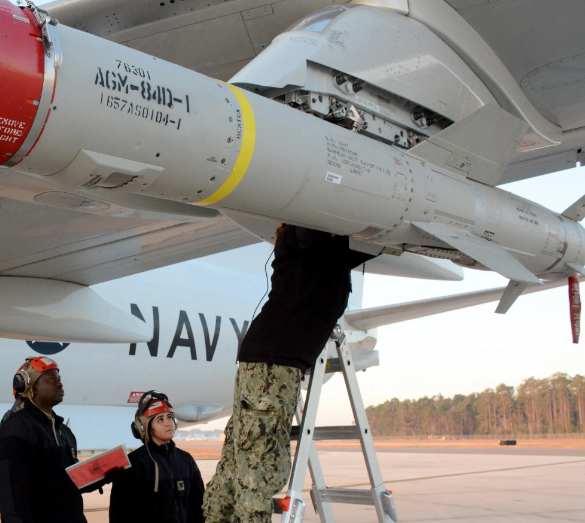
Fixed-wing aircraft (AGM-84), without the solid-fuel rocket booster
Surface ships (RGM-84), fitted with a solid-fuel rocket booster that detaches when expended, to allow the missile's main turbojet to maintain flight
Submarines (UGM-84), fitted with a solid-fuel rocket booster and encapsulated in a container to enable submerged launch through a torpedo tube
Coastal defense batteries (RGM-84), from which it would be fired with a solid-fuel rocket booster
Development

In 1965, the United States Navy began studies for a missile in the 24-nautical-mile (45 km) range class for use against surfaced submarines. The name Harpoon was assigned to the project. The sinking of the Israeli destroyer Eilat in 1967 by a Soviet-built Styx anti-ship missile shocked senior United States Navy officers, who until then had not appreciated the threat posed by anti-ship missiles. In 1970 Chief of Naval Operations Admiral Elmo Zumwalt accelerated the development of Harpoon as part of his "Project Sixty" initiative, hoping to add much-needed striking power to U.S. surface warships such as the Ticonderoga-class cruiser.

The first Harpoon was delivered in 1977; in 2004, Boeing delivered the 7,000th.
Photo Gallery
McDonnell Douglas Boeing Defense, Space & Security
AGM-84 Harpoon
over-the-horizon, anti-ship missile
In service 1977–present




McDonnell Douglas Boeing Defense, Space & Security
AGM-84 Harpoon over-the-horizon, anti-ship missile
In service 1977–present
-
-
-
-
AGM-84 Harpoon Block II+ ER
Specifications Mass 1,523 lb (691 kg) including booster Length - 12.6 ft (3.8 m), air-launched;
- 15 ft (4.6 m), surface- and submarine-launched
Diameter 13.5 in (34 cm) Wingspan 3 ft (0.91 m) Warhead 488 pounds (221 kg) Detonationmechanism Impact fuze Engine Teledyne CAE J402 turbojet/solid propellant booster for surface and submarine launch; greater than 600 lbf (2,700 N) of thrust
-
-
-

-
-
Specifications Operationalrange - Greater than 77 nmi (143 km), ship-launched Harpoon Block I & Block IC;
- Greater than 67 nmi (124 km), ship-launched Harpoon Block II;
- 120 nmi (220 km), air-launched Block IC
Flight altitude Sea-skimming Maximum speed
-
Links to Youtube & Others
The A/U/RGM-84 Harpoon is an all-weather, over-the-horizon, anti-ship missile system that provides the Navy with a common missile for air and ship launches. The weapon system uses mid-course guidance with a radar seeker to attack surface ships

McDonnell Douglas
AGM-84 Harpoon
Harpoon Block II+ will join the Joint Standoff Weapon C-1 as the Navy’s only two air-to-ground network-enabled weapons.

Youtube Link
The updated Harpoon Block II+ provides a rapid-capability enhancement for the Navy that includes a new GPS guidance kit,.
Read more in McDonnell Douglas Boeing Defense, Space & Security
AGM-84 Harpoon
.png)