Russian Aircraft Corporation Mikoyan MiG-25
NATO name: Foxbat
Produced 1964–1984


Russian Aircraft "Mig"
MiG-25 Foxbat
 |
|
| A MiG-25PU two-seat trainer | |
| Role | Interceptor and reconnaissance aircraft |
|---|---|
| National origin | Soviet Union |
| Manufacturer | Mikoyan-Gurevich / Mikoyan |
| First flight | 6 March 1964; 60 years ago |
| Introduction | 1970 |
| Status | In limited service with the Syrian Air Force |
| Primary users | Soviet Air Defence Forces (historical) Indian Air Force (historical) Algerian Air Force (historical) Syrian Air Force |
| Produced | 1964–1984 |
| Number built | 1,186 |
| Developed into | Mikoyan MiG-31 |
|
|
.
History Russian Aircraft Corporation "Mig"
Mikoyan-Gurevich MiG-25 (Russian: Микоян и Гуревич МиГ-25;
NATO reporting name: Foxbat)India, designated Garuda

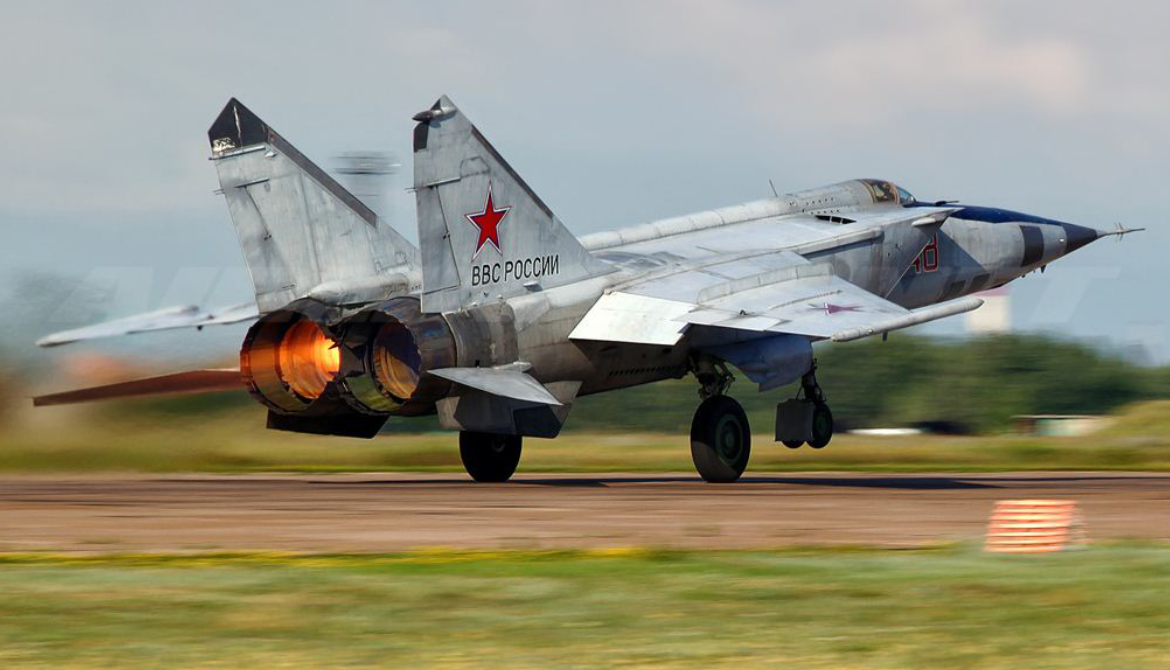
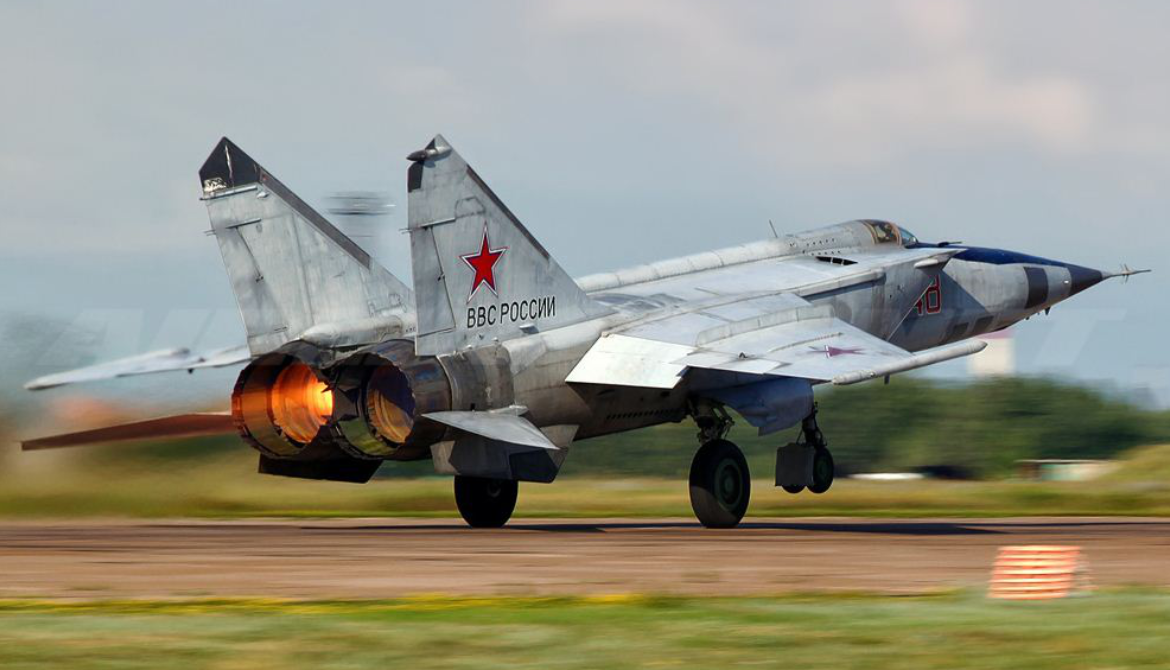
The Mikoyan-Gurevich MiG-25 (Russian: Микоян и Гуревич МиГ-25; NATO reporting name: Foxbat) is a supersonic interceptor and reconnaissance aircraft that is among the fastest military aircraft to enter service. Designed by the Soviet Union's Mikoyan-Gurevich bureau, it is an aircraft built primarily using stainless steel. It was to be the last plane designed by Mikhail Gurevich, before his retirement. The first prototype flew in 1964 and the aircraft entered service in 1970. Although its thrust was sufficient to reach Mach 3.2+, its speed was limited to prevent engines from overheating at higher air speeds and possibly seriously damaging them, and therefore the operational top speed was limited to Mach 2.83. The MiG-25 features a powerful radar and four air-to-air missiles, and it still has the world record for reached altitude of 38 km (125,000 ft).
Development

The design bureau studied several possible layouts for the new aircraft. One had the engines located side by side, as on the MiG-19. The second had a stepped arrangement with one engine amidships, with exhaust under the fuselage, and another in the aft fuselage. The third project had an engine arrangement similar to that of the English Electric Lightning, with two engines stacked vertically. Options two and three were both rejected because the size of the engines meant that either of them would result in a very tall aircraft, which would complicate maintenance.
The idea of placing the engines in underwing nacelles was also rejected because of the dangers of any thrust asymmetry during flight. Having decided on engine configuration, there was thought of giving the machine variable-sweep wings and a second crew member, a navigator. Variable geometry would improve manoeuvrability at subsonic speed, but at the cost of decreased fuel tank capacity. Because the reconnaissance aircraft would operate at high speed and high altitude, the idea was soon dropped. Another interesting but impractical idea was to improve the field performance using two RD36-35 lift-jets. Vertical takeoff and landing would allow for use of damaged runways during wartime and was studied on both sides of the Iron Curtain. The perennial problem with engines dedicated to vertical lift is they become mere dead weight in horizontal flight and also occupy space in the airframe needed for fuel. The MiG interceptor would need all the fuel it could get, so the idea was abandoned.

0
KmCeiling
0
KmCombat RANGE
0
MachAircraft Speed
0
Max Crew
Photo Gallery
Russian Aircraft Corporation "Mig"
Mikoyan-Gurevich MiG-25
NATO reporting name: Foxbat; India, designated Garuda



Russian Aircraft Corporation "Mig"
Mikoyan MiG-29 NATO reporting name: Fulcrum
General Info
-
-
-
-
- Crew: 1
- Length: 23.82 m (78 ft 2 in)
- Wingspan: 14.01 m (46 ft 0 in)
- Height: 6.1 m (20 ft 0 in)
- Wing area: 61.4 m2 (661 sq ft)
-
-
-
Powerplant
-
-
-
- Empty weight: 20,000 kg
- Gross weight: 36,720 kg
- Powerplant: 2 × Tumansky R-15B-300 afterburning turbojet engines, 73.5 kN (16,500 lbf) thrust each dry, 100.1 kN (22,500 lbf) with afterburner
-
-
-

Performance
-
- Maximum speed: 3,000 km/h (1,900 mph, / Mach 2.83 at high altitude
-
-
-
- 1,300 km/h IAS at sea level
-
-
- Range: 1,860 km at Mach 0.9
-
-
-
- 1,630 km (1,013 mi) at Mach 2.35
-
-
- Ferry range: 2,575 km
- Service ceiling: 20,700 m (67,900 ft) with four missiles
-
-
-
- 24,000 m (78,740 ft) with two)
-
-
Armament
-
Missiles:
- 4 × R-40R/T air-to-air missiles with 8 g launch overload
- 4 × R-40RD/TD air-to-air missiles with 8 g launch overload and improved range (MiG-25PD)
- 4 × R-60/R-60M dogfight air-to-air missiles (MiG-25PD)
- 4 × R-60/R-60M dogfight air-to-air missiles + 2 x R-40RD/TD air-to-air missiles (MiG-25PD
Links to Youtube & Others
During the Persian Gulf War, a U.S. Navy F/A-18, piloted by Lieutenant Commander Scott Speicher, was shot down on the first night of the war in the early hours of 17 January 1991 by a missile fired by a MiG-25.[65][66][67] The kill was reportedly made with a Bisnovat R-40TD missile fired from a MiG-25PDS flown by Lt. Zuhair Dawood of the 84th squadron of the IQAF

Russian Aircraft Mig
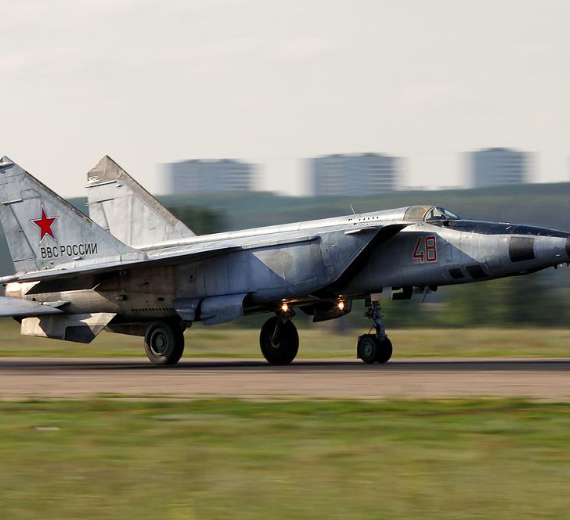
MiG-25 Foxbat
On 13 February 1981, the Israeli Air Force sent two RF-4Es over Lebanon as decoys for Syrian MiG-25 interceptors.
Youtube Link
Two IQAF MiG-25s were shot down by U.S. Air Force F-15s on 19 January. The MiGs attempted to hide from the F-15s by using chaff and electronic jammers in order to engage the F-15s.

Read more in Russian Aircraft Corporation "Mig" Mikoyan MiG-25 Foxbat