
Mil Moscow Helicpter plant
Mil Mi-28 type V-28
NATO reporting name:
'Havoc'
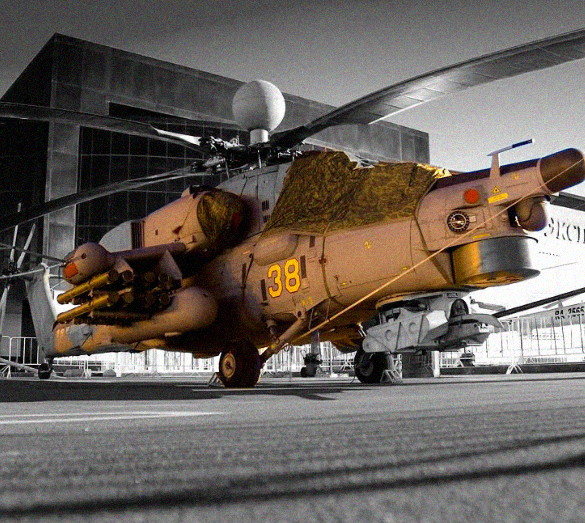

Mil Helicpter plant Mil Mi-28 type V-28 'Havoc'
.jpg) |
|
| General information | |
|---|---|
| Type | Attack helicopter |
| National origin | Soviet Union/Russia |
| Manufacturer | Mil |
| Status | In service |
| Primary users | Russian Aerospace ForcesAlgerian Air Force Iraqi Air Force Uganda Air Force |
| Number built | 126 |
| History | |
| Manufactured | 1982–present |
| Introduction date | 15 October 2009 (Mi-28N) |
| First flight | 10 November 1982 |
|
|
|
|
|---|
.
History Mil Moscow Helicpter plant
Mil Mi-28 type 32
NATO reporting name:
'Havoc'
-
Design

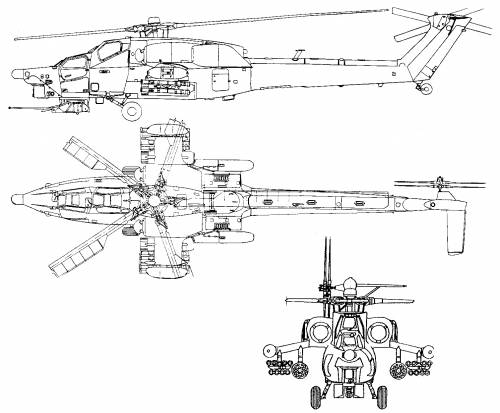
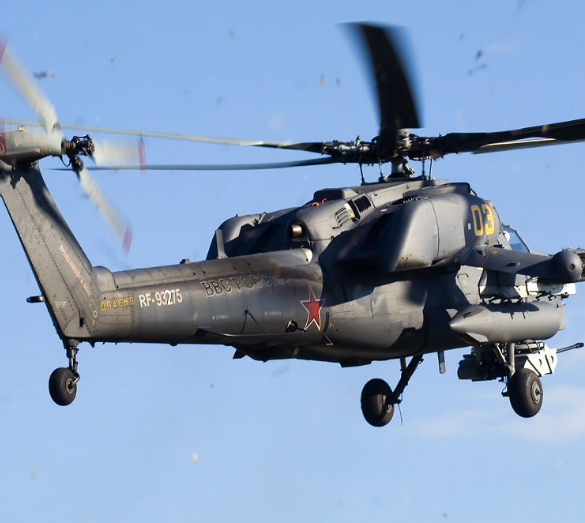
Mi-28N of Berkuts aerobatic team at ARMY-2020 forum The Mi-28 is a new-generation attack helicopter that functions as an air-to-air and air-to-ground partner for the Mi-24 Hind and Ka-50 Hokum. The five-blade main rotor is mounted above the body midsection, short, wide, tapered, weapon-carrying wings are mounted to the rear of the body midsection. Two turboshaft engines in pods are mounted alongside the top of the fuselage with downturned exhausts. The fuselage is slender and tapers to the tail boom and nose. It features tandem, stepped-up cockpits, a cannon mounted beneath the belly, and a non-retractable tricycle tail-wheel type landing gear. Due to the energy-absorbing landing gear and seats the crew can survive a vertical fall of up to 12 m/s. The Mi-28 has a fully armoured cabin, including the windshield, which withstands 7.62 and 12.7 mm armor piercing bullets and 20 mm shell fragments.
The helicopter design is based on the conventional pod and boom configuration, with a tail rotor. The main rotor head has elastomeric bearings and the main rotor blades are made from composite materials. The tail rotor is designed on a biplane configuration, with independently controlled X-shaped blades. A new design of all-plastic rotor blades, which can sustain 30 mm shells, is installed on the Mi-28N night attack variant.

A Russian Air Force Mi-28 It is equipped with two heavily armored cockpits, a windshield able to withstand 12.7–14.5 mm caliber bullets, in-nose electronics, and a narrow-X tail rotor (55 deg), with reduced noise characteristics. It is powered by two 2,200 hp Isotov TV-3-117VM (t/n 014) turboshaft engines.
While the Mi-28 is not intended for use as a transport, it does have a small passenger compartment capable of carrying three people. The planned purpose of this is the rescue of downed helicopter crews.
Variants Military

Mil Mi-28 weapons load 
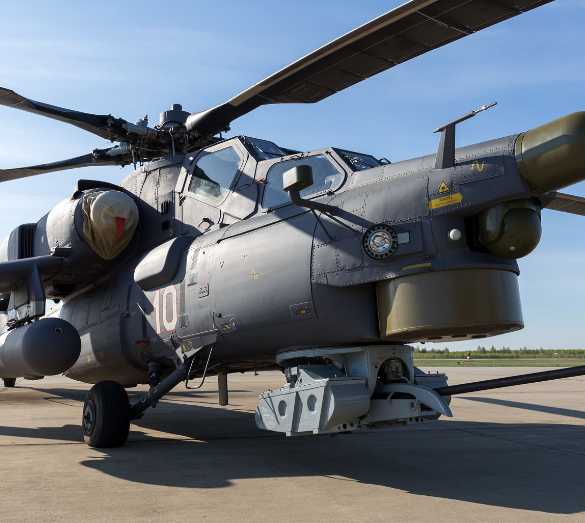
Mil Mi-28 nose sensors


.jpg)

0
KmCeiling
0
KmCombat RANGE
0
Km.hAircraft Speed
0
Max Crew
Photo Gallery
Mil Moscow Helicpter plant
Mil Mi-28 type V-28
NATO reporting name:
'Havoc'
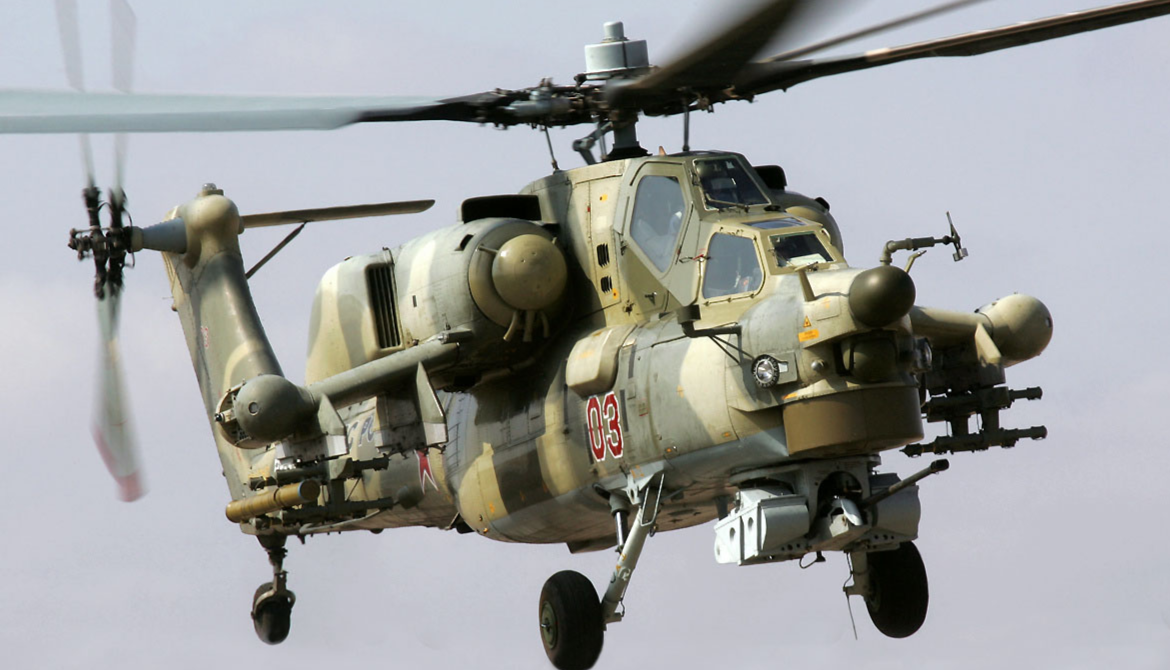
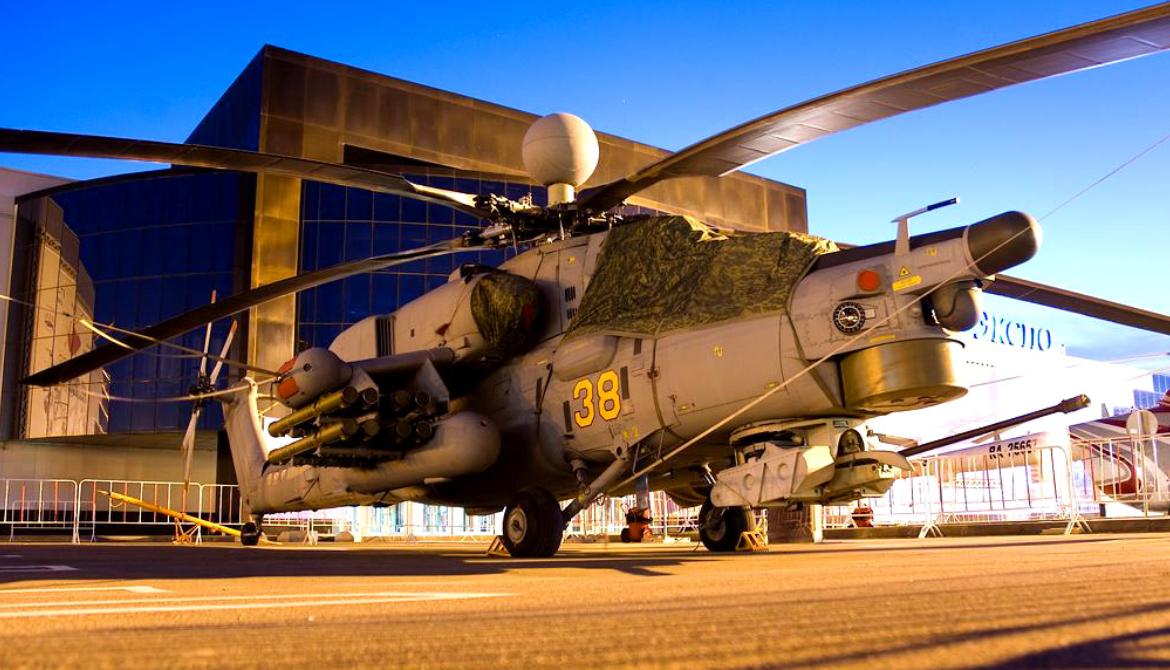



Mil Moscow Helicpter plant Mil Mi-28 type V-28 NATO reporting name: 'Havoc'
General characteristics
- Crew: 2 (1 pilot, 1 WSO)
- Length: 17.01 m (55 ft 10 in) excluding rotors
- Wingspan: 4.88 m
- Height: 3.82 m to top of rotor head
- Empty weight: 8,590 kg
-
Powerplant
- Powerplant: 2 × Klimov VK-2500 turboshaft engines, 2,194 hp) each
- Main rotor diameter: 17.2 m
- Main rotor area: 232.35 m2
Specifications
- Maximum speed: 320 km/h (200 mph, 170 kn)
- Cruise speed: 270 km/h (170 mph, 150 kn) max
- Range: 435 km (270 mi, 235 nmi) with 5% reserve
- Combat range: 200 km (120 mi, 110 nmi) 10-minute loiter with 5% reserve
- Ferry range: 1,100 km (680 mi, 590 nmi) 4x drop tanks with 5% reserve
- Endurance: 2 hours
- Service ceiling: 5,700 m (18,700 ft)
Armament
-
-
-
- Guns: 1× chin-mounted 30 mm Shipunov 2A42 cannon with 250 rounds (±110° horizontal fire)
- Hardpoints: Two pylons under each stub wing to mount bombs, rockets, missiles, and gun pods.
-
-
-
-
Links to Youtube & Others
The Mil Mi-28 Havoc dates back to the early 1980s, an era marked by significant advancements in military technology. The Soviet Union recognized the need for a helicopter that was specifically engineered for attack missions, moving away from the practice of modifying transport variants for combat. This led to the Mi-28, a chopper that experienced a tumultuous design period before the Russians adopted it in the late 2000s.

Mil Helicpter plant
Mil Mi-28 type V-28 'Havoc'
Shortly after the introduction of the Mil Mi-24 Hind into service, the Soviet Union began working on a new helicopter that had a focus on speed and agility
Youtube Link
Outside of its armaments, the Mi-28 also gives pilots a helmet-mounted display, allowing them to locate targets for their weapons officers or navigators to fire at.
Read more in Russian Aviation


.png)
.png)