Northrop
F-20A Tigershark
First flight 30 August 1982


Northrop
F-20 Tigershark
 |
|
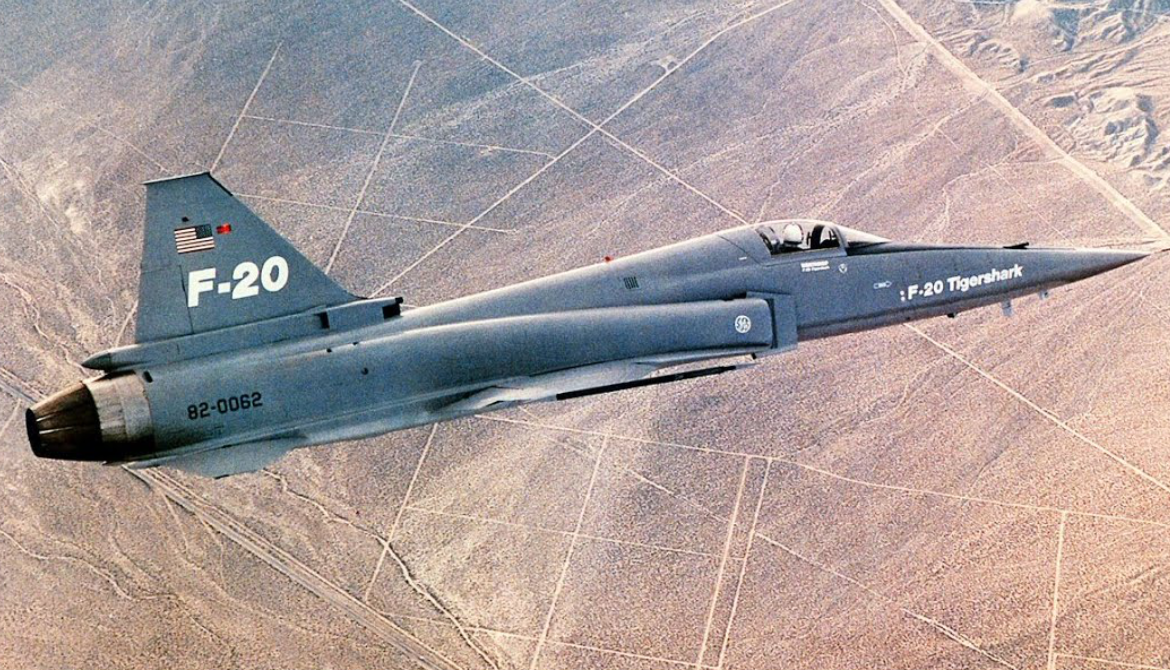
| F-20 prototype 82-0062 | |
| Role | Fighter aircraft |
|---|---|
| National origin | United States |
| Manufacturer | Northrop Corporation |
| First flight | 30 August 1982 |
| Status | Canceled |
| Number built | 3 |
| Developed from | Northrop F-5 |
.
History Northrop
Northrop
F-20 Tigershark
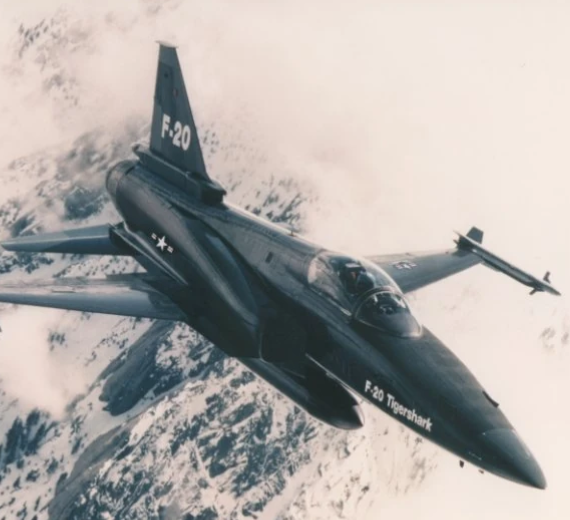
 The Northrop F-20 Tigershark (initially F-5G) is a light fighter, designed and built by Northrop. Its development began in 1975 as a further evolution of Northrop's F-5E Tiger II, featuring a new engine that greatly improved overall performance, and a modern avionics suite including a powerful and flexible radar. Compared with the F-5E, the F-20 was much faster, gained beyond-visual-range air-to-air capability, and had a full suite of air-to-ground modes capable of utilizing most U.S. weapons. With these improved capabilities, the F-20 became competitive with contemporary fighter designs such as the General Dynamics F-16 Fighting Falconbut was much less expensive to purchase and operate.
The primary design change between the earlier F-5E and the F-20 was the use of a single General Electric F404 engine, which was originally designed for the F/A-18 Hornet. The new engine provided 60% more thrust than the combined output of the F-5E's two General Electric J85s. This improved the aircraft's thrust-to-weight ratio from 1.0 to 1.13. The new engine gave a speed of over Mach 2.0, a ceiling over 55,000 ft (16,800 m), an initial climb rate of 52,800 ft per minute (16,100m/min)
Development
Operational history

0
KmCeiling
0
KmCombat RANGE
0
MachAircraft Speed
0
Max Crew
Photo Gallery
Northrop F-20 Tigershark




Northrop Corporation
Northrop F-20 Tigershark
General Info
-
- Crew: 1
- Length: 47 ft 4 in (14.43 m)
- Wingspan: 27 ft 11.875 in (8.53123 m) with wing-tip missiles
-
-
-
- 26 ft 8 in (8.13 m) clean
-
-
- Height: 13 ft 10.25 in (4.2228 m)
Powerplant
- Empty weight: (5,357 kg)
- Gross weight: (7,264 kg)
Combat TOW - 50% fuel 2x AIM-9 - Max takeoff weight: (12,474 kg)
- Fuel capacity: (2,291 kg) in integral and bladder tanks
- Powerplant: 1 × General Electric F404-GE-100 afterburning turbofan engine, 11,000 lbf (49 kN) thrust dry,

Performance
- Maximum speed: 1,147 kn (1,320 mph, 2,124 km/h)
- Maximum speed: Mach 2
- Range: 320 nmi (370 mi, 590 km) in air superiority mission with 2 × AIM-9 and 5 minutes air combat
- Service ceiling: 56,800 ft (17,300 m)
Armament
- Guns: 2 × 20 mm (0.79 in) Pontiac M39A2 cannons in the nose, 280 rounds each and a General Electric 30 mm gun pod which can be mounted on the fuselage
- Hardpoints: 7 external hardpoints with a capacity of 8,000 lb (3,600 kg)
.
Links to Youtube & Others
The F-20 would also make greater usage of composite materials in its construction. During its development, several areas using metal were re-designed to use fiberglass, and there were numerous upgrades to various mechanical parts.

Northrop
F-20 Tigershark
As the Mikoyan-Gurevich MiG-21 became more common, the U.S. Air Force initiated the International Fighter Aircraft (IFA) program to provide an equivalent to allies.

Youtube Link
The future of the FX program seemed doubtful. Following an agreement to sell F-16s to Pakistan.
Read more in Northrop Aviation