Avro International Aerospace.
AVRO B.1 Vulcan
Nickname "Tin Triangle"
First flight 30 August 1952
Introduction September 1956


Avro Int. Aerospace
AVRO B.1,B.2 Vulcan
_Avro_Vulcan_-_Last_Flight_over_Farnborough_(cropped).jpg) |
|
| Avro Vulcan XH558 over Farnborough, 2015 | |
| Role | Strategic bomber |
|---|---|
| National origin | United Kingdom |
| Manufacturer | Avro Hawker Siddeley Aviation |
| First flight | 30 August 1952 |
| Introduction | September 1956 |
| Retired | March 1984 (Royal Air Force)October 2015 (XH558) |
| Status | Retired |
| Primary user | Royal Air Force |
| Produced | 1956–1965 |
| Number built | 136 (including prototypes) |
| Developed into | Avro Atlantic (proposed) |
.
History Avro International Aerospace
AVRO B.1,B.2 Vulcan First flight 30 August 1952
Introduction September 1956

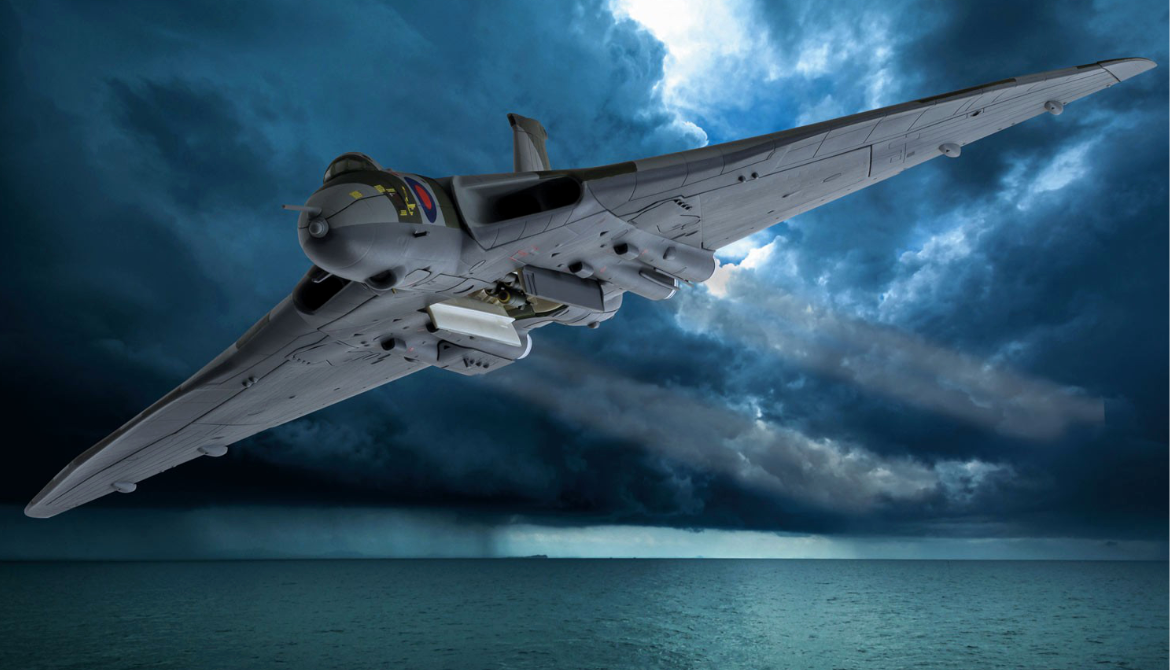
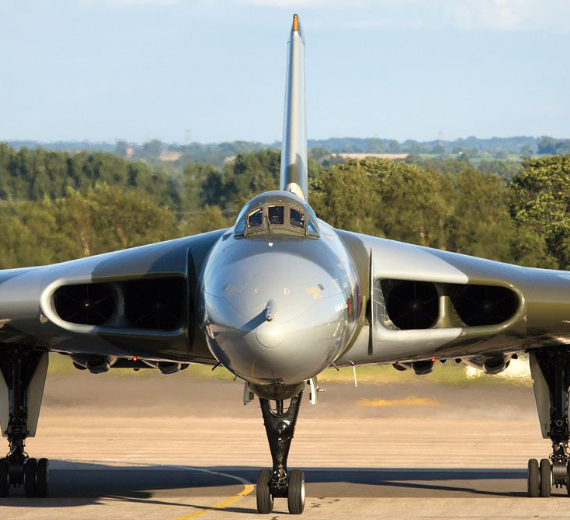
The Avro Vulcan (later Hawker Siddeley Vulcan from July 1963) is a jet-powered, tailless, delta-wing, high-altitude, strategic bomber, which was operated by the Royal Air Force (RAF) from 1956 until 1984. Aircraft manufacturer A.V. Roe and Company (Avro) designed the Vulcan in response to Specification B.35/46. Of the three V bombers produced, the Vulcan was considered the most technically advanced, hence the riskiest option. Several reduced-scale aircraft, designated Avro 707s, were produced to test and refine the delta-wing design principles.
The Vulcan B.1 was first delivered to the RAF in 1956; deliveries of the improved Vulcan B.2 started in 1960. The B.2 featured more powerful engines, a larger wing, an improved electrical system, and electronic countermeasures, and many were modified to accept the Blue Steel missile. As a part of the V-force, the Vulcan was the backbone of the United Kingdom's airborne nuclear deterrent during much of the Cold War. Although the Vulcan was typically armed with nuclear weapons, it could also carry out conventional bombing missions, which it did in Operation Black Buck during the Falklands War between the United Kingdom and Argentina in 1982.
.
Development
Further information: V bombers
0
KmCeiling
0
KmCombat RANGE
0
Km/hAircraft Speed
0
Max Crew
Photo Gallery
Avro International Aerospace
AVRO B.1,B.2 Vulcan First flight 30 August 1952
Introduction September 1956




Avro Int. Aerospace
AVRO B.1,B.2 Vulcan First flight 30 August 1952
Introduction September 1956
General Info
-
-
-
- Crew: 5 (pilot, co-pilot, AEO, navigator radar, navigator plotter)
- Length: 97 ft 1 in (29.59 m)
- Wingspan: 99 ft 5 in (30.30 m)
- Height: 26 ft 6 in (8.08 m)
- Wing area: 3,554 sq ft (330.2 m2)
-
-
Powerplant
-
-
Engines 4 × Bristol SiddeleyOlympus 200-series, 301 Fuel capacity(main) 9,280 imp gal (11,140 US gal; 42,200 L) / 74,240 lb (33,675 kg) avtur)
-

Performance
-
- Maximum speed: 561 kn (646 mph, 1,039 km/h) at altitude
- Maximum speed: Mach 0.96
- Cruise speed: 493 kn (567 mph, 913 km/h) / M0.86 at 45,000 feet (14,000 m)
- Range: 2,265 nmi (2,607 mi, 4,195 km)
- Service ceiling:(17,000 m)
Related development
-
-
Armament 1 × free-fall nuclear bomb or
21 × 1,000 lb (450 kg)conventional bombs
-
.
Links to Youtube & Others
Although in operational use, the Vulcan typically carried various nuclear armaments, the type also had a secondary conventional role. While performing conventional combat missions, the Vulcan could carry up to 21 1,000 lb (454 kg) bombs inside its bomb bay.

Avro Int.
Avro B.2 Vulcan
The Vulcan's only combat missions took place towards the end of the type's service in 1982. During the Falklands War.

Youtube Link
The missions performed by the Vulcan became known as the Black Buck raids, each aircraft had to fly 3,889 mi (6,259 km) from Ascension Island to reach Stanley on the Falklands. Victor tankers conducted the necessary air-to-air refuelling.
Read more in Avro (an initialism of the founder's name) was a British aircraft manufacturer.
.



.svg.png)