Fairey Aviation Company
Fairey FB-1 Gyrodyne


Fairey Aviation
Fairey FB-1 Gyrodyne
 |
|
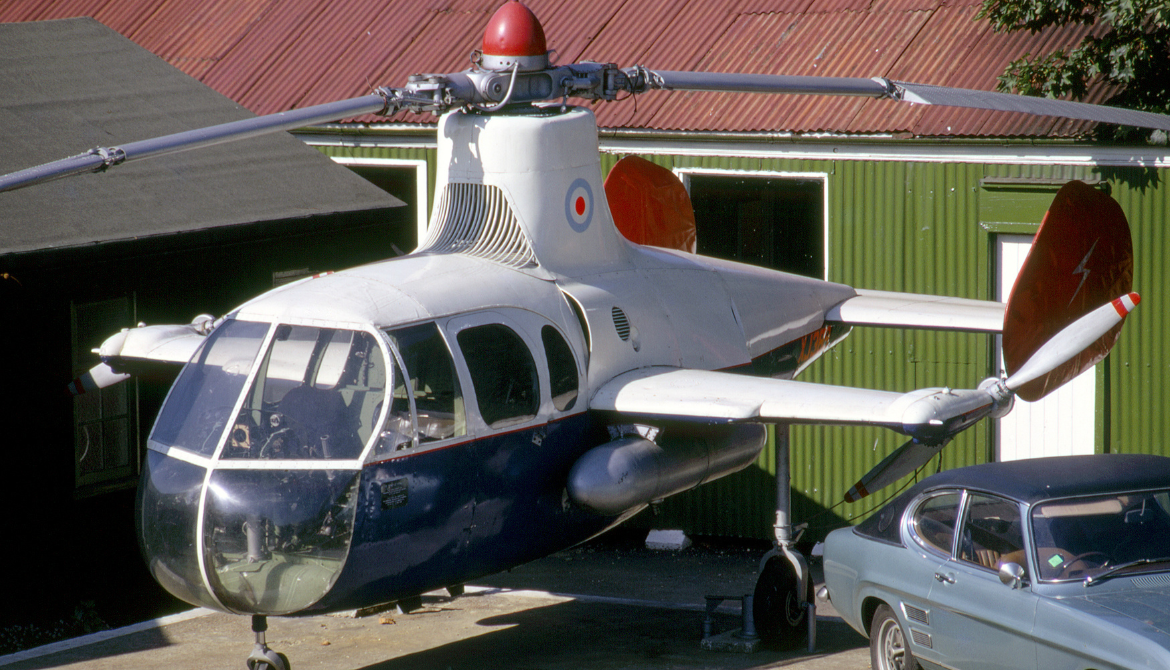
| The Fairey FB-1 Gyrodyne prototype in test | |
| Role | Gyrodyne |
|---|---|
| National origin | United Kingdom |
| Manufacturer | Fairey |
| Designer | Dr. J.A.J. Bennett |
| First flight | 4 December 1947 |
| Retired | Cancelled 1949 |
| Number built | 2 |
| Variants | Fairey Jet Gyrodyne |
|
|
|---|
.
History Fairey Aviation Company Limited
Fairey FB-1 Gyrodyne

In April 1946, Fairey announced a private-venture project for a rotary-wing aircraft, to be built to a design developed by Dr. J.A.J. Bennett while he was chief technical officer at the Cierva Autogiro Company in 1936–1939. The Gyrodyne, constituting a third distinct type of rotorcraft and designated C.41 by the Cierva Autogiro Company, was in 1938 successfully tendered to the Royal Navy in response to Specification S.22/38 for a naval helicopter. Though preliminary work started on the project, it was abandoned with the outbreak of the Second World War, and G & J Weir, Ltd., the financiers of the Cierva Autogiro Company, declined to undertake further development in addition to their successful experiments with the W.5 and W.6 lateral twin-rotor helicopters
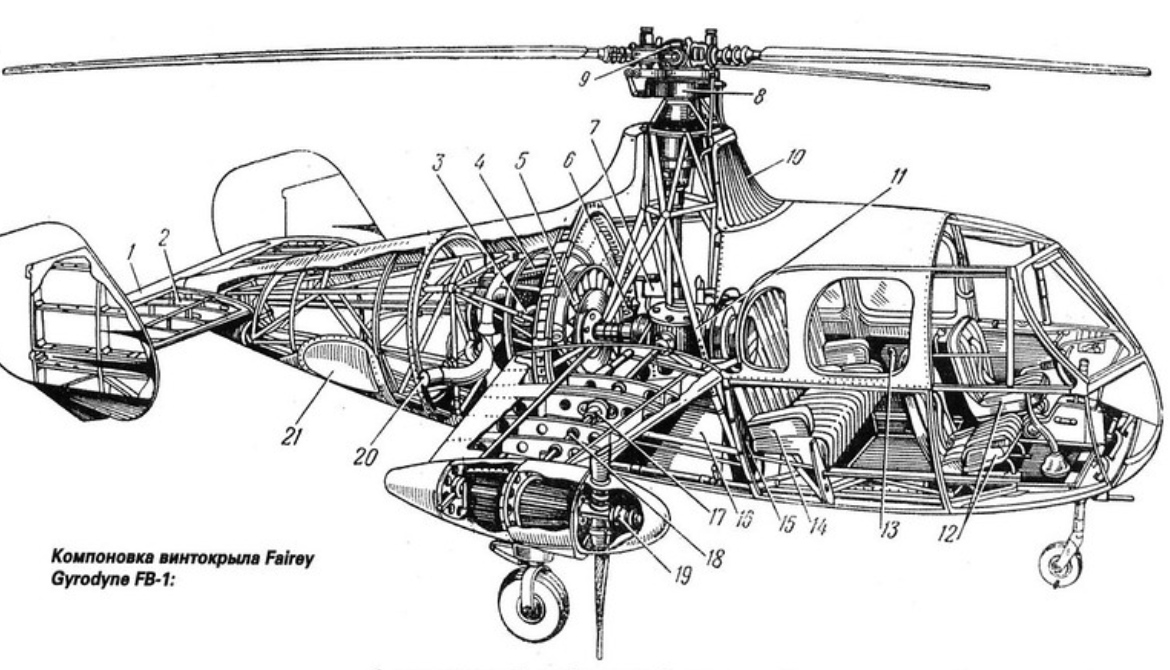
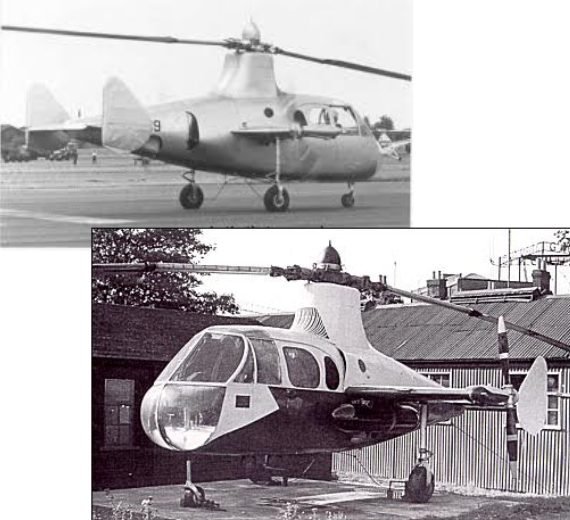
The Fairey FB-1 Gyrodyne is an experimental British rotorcraft that used single lifting rotor and a tractor propeller mounted on the tip of the starboard stub wing to provide both propulsion and anti-torque reaction.

-
Design
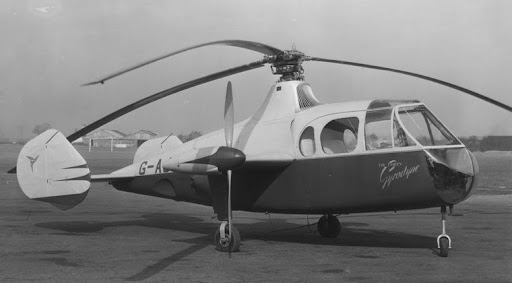
Fairey Rotodyne On 4 December 1947, the first of the two prototypes took off from White Waltham airfield, and continued to build up flying time until March 1948 when it was dismantled for a thorough examination. The second prototype, basically similar to the first but with more comfortable interior furnishings befitting its role as a passenger demonstrator, was flying by the time of the next SBAC Farnborough Airshow, in September 1948. The first prototype was reassembled and, following further test flying, took part in an attempt to set a new world helicopter speed record in a straight line
Photo Gallery
Fairey Aviation Company Limited
Fairey FB-1 Gyrodyne

Fairey Aviation Company Limited
Fairey FB-1 Gyrodyne
General Info 1
-
-
- Crew: One
- Capacity: Four to five passengers
- Length: 25 ft 0 in (7.62 m) Fuselage nose to trailing edges of rudders
- Wingspan: 17 ft 8 in (5.38 m)
- Height: 10 ft 1 in (3.07 m)
-
General Info 2
-
-
- Empty weight: (1,629 kg)
- Max takeoff weight: (2,177 kg)
- Fuel capacity: 50 imp gal (227.3 L; 60.0 US gal) fuel,
- Powerplant: 1 × Alvis Leonides 522/2 9-cyl. air-cooled radial piston engine, 520 hp (390 kW) at 3,000 rpm
- Main rotor diameter: (15.768 m)
-
General Info 3
- Maximum speed: (140 mph, 230 km/h)
- Range: 216 nmi (248 mi, 399 km)
- Service ceiling: (3,050 m)
General Info 4
.
Links to Youtube & Others
The Gyrodyne was a compact, streamlined rotorcraft weighing just over 4,410 lb (2,000 kg) and powered by a 520–540 hp (390–400 kW) Alvis Leonides 522/2 radial engine, the power from which could be transmitted in variable ratios to the fixed-shaft/swashplate-actuated tilting hub-controlled rotor and the wing tip mounted propeller

Fairey Aviation
Fairey FB-1 Gyrodyne
The Gyrodyne was a compact, streamlined rotorcraft weighing just over 4,410 lb (2,000 kg) and powered by a 520–540 hp (390–400 kW)
Youtube Link
The Gyrodyne was a compact, streamlined rotorcraft weighing just over 4,410 lb (2,000 kg) and powered by a 520–540 hp (390–400 kW)

Read more in Fairey Aircraft Company Limited Fairey FB-1 Gyrodyne
.