Aérospatiale/BAC Concorde
BAC Concorde SST
First flight 2 March 1969
Produced 1965–1979
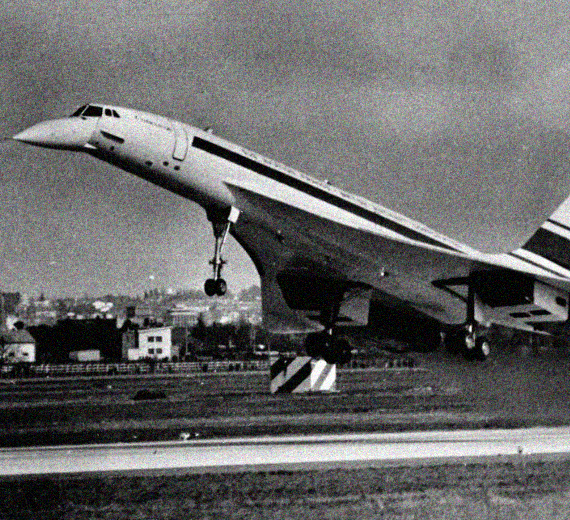

Aérospatiale/BAC
Concorde SST

|
|
| General information | |
|---|---|
| Type | Supersonic airliner |
| National origin | France and United Kingdom |
| Manufacturer |
|
| Status | Retired |
| Primary users | British AirwaysAir France See Operators below for others |
| Number built | 20 (including 6 non-commercial aircraft)[ |

.
History Aérospatiale/BAC Concorde SST
First flight 2 March 1969, Produced 1965–1979
The Aérospatiale/BAC Concorde (/ˈkɒŋkɔːrd/) is a retired Franco-British supersonic airliner jointly developed and manufactured by Sud Aviation (later Aérospatiale) and the British Aircraft Corporation (BAC). Studies started in 1954, and France and the UK signed a treaty establishing the development project on 29 November 1962, as the programme cost was estimated at £70 million (£1.39 billion in 2021). Construction of the six prototypes began in February 1965, and the first flight took off from Toulouse on 2 March 1969. The market was predicted for 350 aircraft, and the manufacturers received up to 100 option orders from many major airlines. On 9 October 1975, it received its French Certificate of Airworthiness, and from the UK CAA on 5 December
Delays and cost overruns increased the programme cost to £1.5–2.1 billion in 1976, (£9–13.2 billion in 2021). Concorde entered service on 21 January of that year with Air France from Paris-Roissy and British Airways from London Heathrow. Transatlantic flights were the main market, to Washington Dulles from 24 May, and to New York JFK from 17 October 1977. Air France and British Airways remained the sole customers with seven airframes each, for a total production of twenty. Supersonic flight more than halved travel times, but sonic booms over the ground limited it to transoceanic flights only..
Testing
_-_53Fi1931_-_cropped.jpg)
The design work was supported by a preceding research programme studying the flight characteristics of low ratio delta wings. A supersonic Fairey Delta 2 was modified to carry the ogee planform, and, renamed as the BAC 221, used for flight tests of the high-speed flight envelope; the Handley Page HP.115 also provided valuable information on low-speed performance.
Construction of two prototypes began in February 1965: 001, built by Aérospatiale at Toulouse, and 002, by BAC at Filton, Bristol. Concorde 001 made its first test flight from Toulouse on 2 March 1969, piloted by André Turcat, and first went supersonic on 1 October. The first UK-built Concorde flew from Filton to RAF Fairford on 9 April 1969, piloted by Brian Trubshaw. Both prototypes were presented to the public for the first time on 7–8 June 1969 at the Paris Air Show. As the flight programme progressed, 001 embarked on a sales and demonstration tour on 4 September 1971, which was also the first transatlantic crossing of Concorde. Concorde 002 followed suit on 2 June 1972 with a tour of the Middle and Far East. Concorde 002 made the first visit to the United States in 1973, landing at the new Dallas/Fort Worth Regional Airport to mark that airport's opening.

While Concorde had initially held a great deal of customer interest, the project was hit by a large number of order cancellations. The Paris Le Bourget air show crash of the competing Soviet Tupolev Tu-144 had shocked potential buyers, and public concern over the environmental issues presented by a supersonic aircraft—the sonic boom, take-off noise and pollution—had produced a shift in public opinion of SSTs. By 1976 the remaining buyers were from four countries: Britain, France, China, and Iran. Only Air France and British Airways (the successor to BOAC) took up their orders, with the two governments taking a cut of any profits made
0
KmCeiling
0
KmMax RANGE
0
Km/hAircraft Speed
0
Max Crew
Photo Gallery
Aérospatiale/BAC Concorde SST
First flight 2 March 1969, Produced 1965–1979
Aérospatiale/BAC Concorde
BAC Concorde SST
General Info
-
-
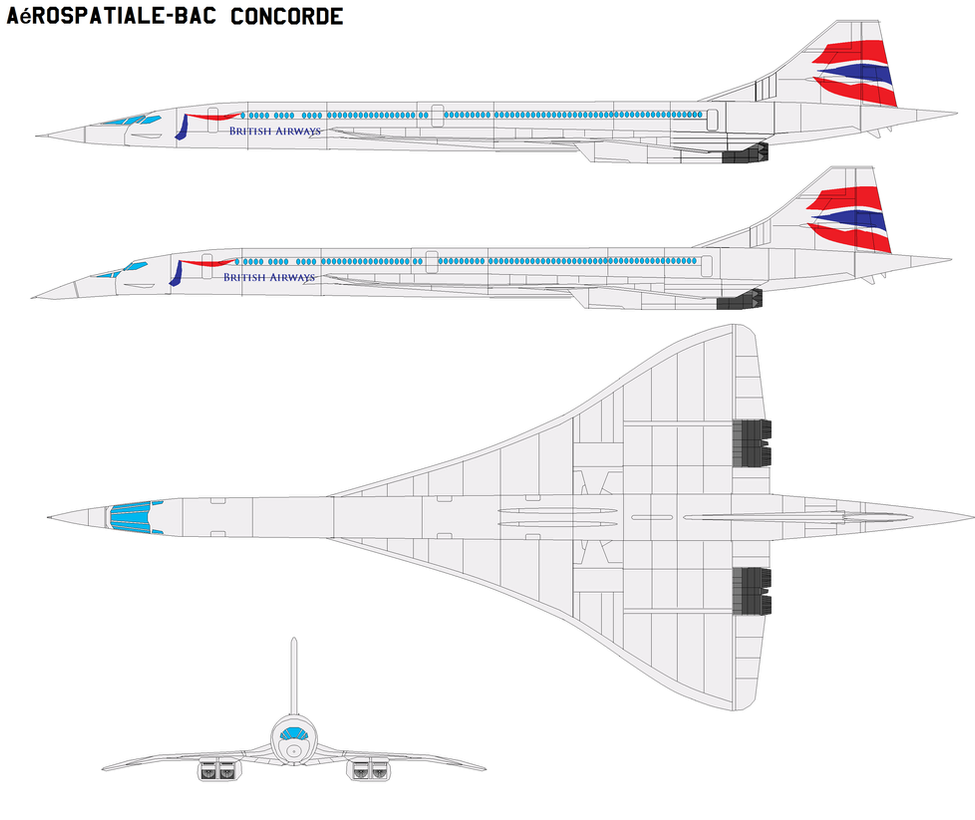
- Crew: 3 (2 pilots and 1 flight engineer)
- Capacity: 92–120 passengers
(128 in high-density layout) - Length: 202 ft 4 in (61.66 m)
- Wingspan: 84 ft 0 in (25.6 m)
- Height: 40 ft 0 in (12.2 m)
- Wing area: (358.25 m2)
-
Powerplant
-
- Empty weight: (78,700 kg)
- Gross weight: (111,130 kg)
- Max takeoff weight: (185,070 kg)
- Fuel capacity: 210,940 lb (95,680 kg); 119,600 L
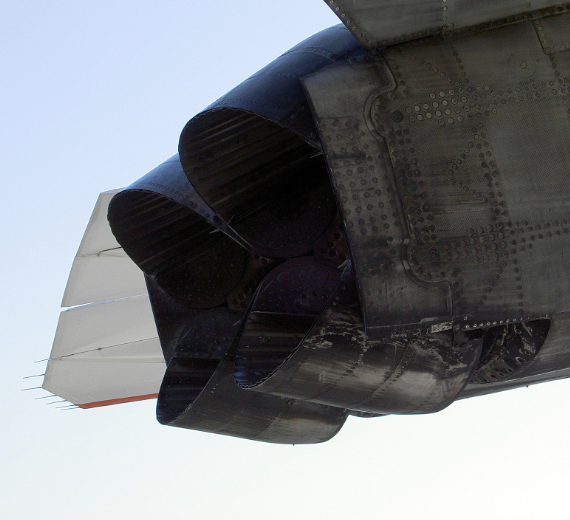
- Powerplant: 4 × Rolls-Royce/Snecma Olympus 593 Mk 610 turbojets with reheat, 31,000 lbf (140 kN) thrust each dry, 38,050 lbf (169.3 kN) with afterburner
-
Performance
- Maximum speed: 1,354 mph (2,179 km/h, 1,177 kn)
- Maximum speed: Mach 2.04 (temperature limited)
- Cruise speed: 1,341 mph (2,158 km/h,
- Range: 4,488.0 mi (7,222.8 km,
- Service ceiling: 60,000 ft (18,300 m)
- Rate of climb: 3,300–4,900 ft/min
- Lift-to-drag: Low speed– 3.94; Approach– 4.35; 250 kn, 10,000 ft– 9.27; Mach 0.94– 11.47, Mach 2.04– 7.14
- Fuel consumption: 47 lb/mi (13.2 kg/km)
.
Links to Youtube & Others
The fastest transatlantic airliner flight was from New York JFK to London Heathrow on 7 February 1996 by the British Airways G-BOAD in 2 hours, 52 minutes, 59 seconds from take-off to touchdown aided by a 175 mph (282 km/h) tailwind. On 13 February 1985, a Concorde charter flight flew from London Heathrow to Sydney—on the opposite side of the world—in a time of 17 hours, 3 minutes and 45 seconds, including refuelling stops.

Aérospatiale/BAC Concorde
The heads of France and the United Kingdom flew in Concorde many times. Presidents Georges Pompidou,] Valéry Giscard d'Estaing and François Mitterrand.

Youtube Link
Concorde was normally perceived as a privilege of the rich, but special circular or one-way (with return by other flight or ship) charter flights were arranged to bring a trip within the means of moderately well-off enthusiasts.
Read more in Aérospatiale/BAC Concorde