
Xi'an Aircraft Company
Xi'an JH-7 Flounder
"Flying Leopard"
First flight 14 December 1988


Xi'an Aircraft Company
Xi'an JH-7 Flounder
|
|||||||||||||||||||||||||

|
|
|---|
.
History Xi'an Aircraft Company Limited
Xi'an JH-7 Flounder
"Flying Leopard"
First flight 14 December 1988

-
Design
JH-7A

JH-7A at the Beijing Military Museum during the "Our troops towards the Sun" exhibition 
Two JH-7As at Chelyabinsk Shagol Air Base When the PLA examined the future role of air forces, it identified a need for precision air-to-surface capability. An improved JH-7, the JH-7A, was designed to meet this requirement. The JH-7A's general and deputy general designers were Tang Changhong (唐长红) and Wu Jieqin (吴介琴) respectively.
The JH-7A had a lighter and stronger airframe than the JH-7, allowing the newer aircraft to carry a maximum ordnance load of 9,000 kg. In PLANAF, this allowed four YJ-81 anti-ship missiles to be carried, compared to the two on the JH-7.
Operational history
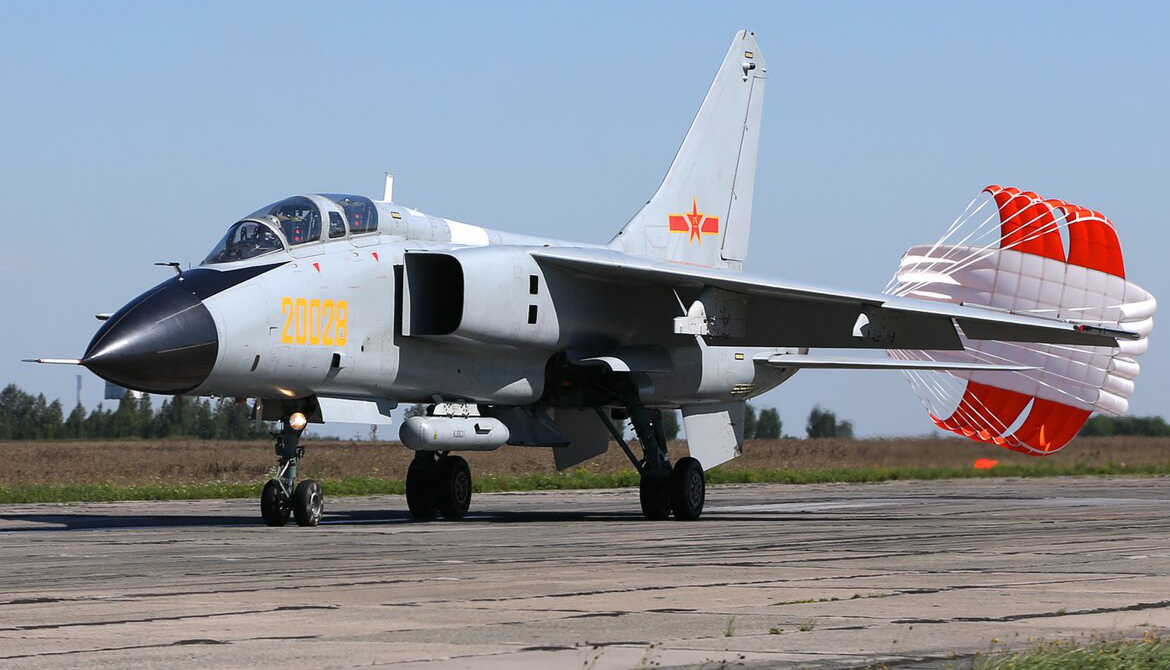
On 19 August 1992, a JH-7 made an emergency landing after the rudder fell off at an altitude of 5,000 meters during a test flight. Huang Bingxin, the pilot, refused to jettison the payload of four live missiles and abandon the aircraft, and instead used differential thrust from the two engines to return to the airport. A starboard tire burst on touchdown and the aircraft was brought to a halt with the .


0
KmCeiling
0
KmMAX RANGE
0
machAircraft Speed
0
Max Crew
Photo Gallery
Xi'an Aircraft Company Limited
Xi'an JH-7 Flounder
"Flying Leopard"
First flight 14 December 1988




Xi'an Aircraft Company Limited
Xi'an JH-7 Flounder
"Flying Leopard"
First flight 14 December 1988
General characteristics
- Crew: 2
- Length: 22.32 m (73 ft 3 in)
- Wingspan: 12.8 m (42 ft 0 in)
- Height: 6.22 m (20 ft 5 in)
- Wing area: 42.2 m2 (454 sq ft)
-
Powerplant
- Empty weight: 14,500 kg (31,967 lb)
- Max takeoff weight: 28,475 kg (62,777 lb)
- Powerplant: 2 × Xian WS-9 Qinling turbofan engines, 54.29 kN (12,200 lbf) thrust each dry, 91.26 kN (20,520 lbf) with afterburner

Specifications
- Maximum speed: 1,808 km/h
- Maximum speed: Mach 1.52
- Combat range: 1,760 km (1,090 mi, 950 nmi) with one in-flight refueling (estimated)
-
-
- Service ceiling: 16,000 m (52,000 ft)
Armament
-
-
- Guns: 1× 23mm twin-barrel GSh-23L autocannon, 300 rounds
- Hardpoints: 9 in total (6× under-wing, 2× wing-tip, 1× under-fuselage) with a capacity of 9,000 kg (20,000 lb) external fuel and ordnance
-
-
-
Links to Youtube & Others
Xian JH-7 or Jian Hong-7, NATO code name Flounder, otherwise known as Flying Leopard, was a two-seat Chinese fighter-bomber designed to replace the Chinese ageing fleet of Harbin H-5 and Nanchang Q-5 aircraft. The JH-7 entered service shortly before the introduction of the Russian Su-27 air superiority fighter into Chinese service, which alongside its more advanced variants such as the Su-30 and domesticall.

Xi'an Aircraft Company
Xi'an JH-7 Flounder
In the early 1970s, China started a program to replace the Nanchang Q-5 for the PLAAF and the PLANAF.

Youtube Link
On 19 August 1992, a JH-7 made an emergency landing after the rudder fell off at an altitude of 5,000 meters during a test flight. Huang Bingxin,.

Read more in
Shaanxi Aircraft Corporation
Aviation Industry Corporation of China


.png)
.png)