
Hawker Siddeley Aircraft
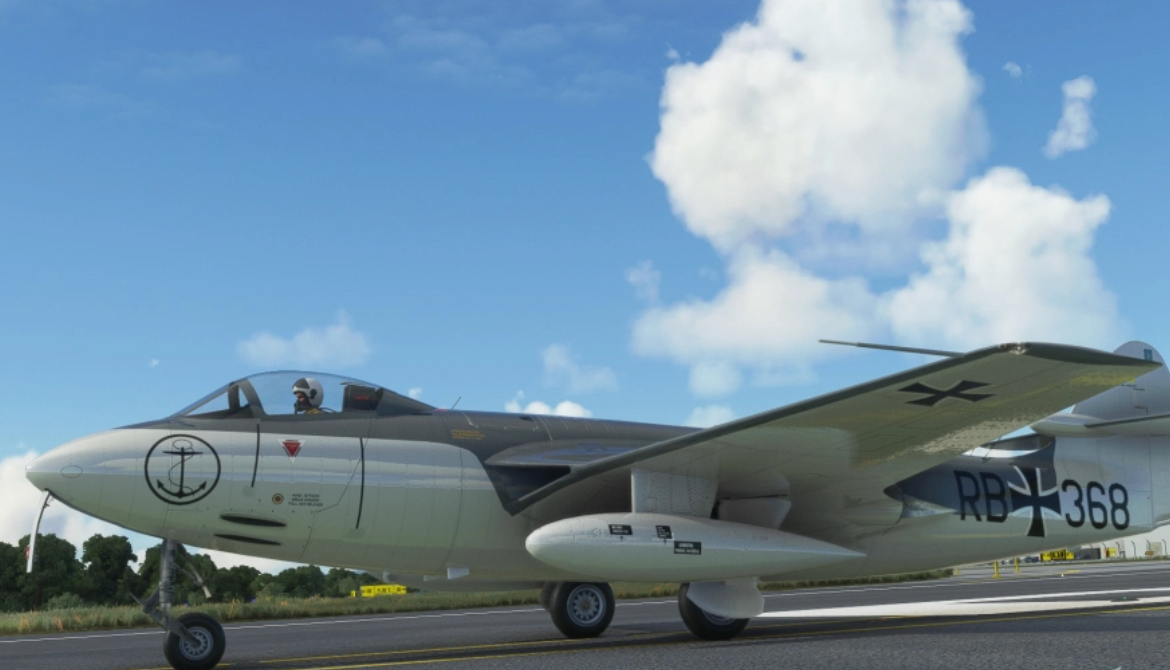
Hawker Seahawk “Nene’s Fury”
Introduction date March 1953
First flight 2 September 1947
Retired 1983


Hawker aircraft Ltd.
Hawker Seahawk FB.11
|
|
||||||||||||||||||||||||||
|---|---|---|---|---|---|---|---|---|---|---|---|---|---|---|---|---|---|---|---|---|---|---|---|---|---|---|---|
crop.jpg)
|
|
|---|
.
History Hawker Siddeley Aircraft
Hawker Seahawk “Nene’s Fury”
Introduction date March 1953 First flight 2 September 1947
Retired 1983

The Hawker Sea Hawk is a British single-seat jet day fighter formerly of the Fleet Air Arm (FAA), the air branch of the Royal Navy (RN), built by Hawker Aircraft and its sister company, Armstrong Whitworth Aircraft. Although its design originated from earlier Hawker piston-engined fighters, the Sea Hawk was the company's first jet aircraft.
Following acceptance in the RN, the Sea Hawk proved to be a reliable and sturdy workhorse. A considerable number were also produced for the export market and were operated from aircraft carriers in Dutch and Indian service. The last operational Sea Hawks, operated by the Indian Navy, were retired in 1983.
Design

In December 1944 Hawker refined the proposed design substantially. The jet exhaust was moved from beneath the tail and re-designed as two short split-lateral bifurcated exhausts (which gained the name "trouser legs"), embedded in the trailing edge of the wing root, which needed a corresponding thickening of the wing root; the air intakes were moved to the wing root leading edge, similar to the contemporary de Havilland Vampire. The shorter unusual bifurcated jet pipe reduced pressure losses in the jet pipe and had the additional advantage of freeing up space in the rear fuselage for fuel tanks, which gave the aircraft a longer range than many other early jets. The absence of wing fuel tanks also meant a thinner wing could be adopted without the penalty of reduced range; to ease manufacture, the elliptical wingform of the Fury was discarded in favour of a straight tapered wing design. The fuselage fuel tanks, being fore and aft of the engine, also provided for a stable centre of gravity during flight. The tail plane was raised to clear the jet exhausts. The Sea Hawk also featured a nose wheel undercarriage arrangement, the first for a Hawker-built aircraft. The aircraft was built to accommodate four 20mm Hispano-Suiza Mk. V cannon.

0
KmCeiling
0
KmCombat RANGE
0
KM/hAircraft Speed
0
Max Crew
Photo Gallery
Hawker Siddeley Aircraft
Hawker Seahawk “Nene’s Fury”
Introduction date March 1953 First flight 2 September 1947


Hawker Siddeley Aircraft
Hawker Seahawk Introduction date March 1953 First flight 2 September 1947
General Info
-
-
-
- Crew: 1
- Length: 39 ft 8 in (12.09 m)
- Wingspan: 39 ft 0 in (11.89 m)
- Height: 8 ft 8 in (2.64 m)
- Wing area: 278 sq ft (25.8 m2)
-
-
Powerplant
-
-
- Empty weight: 9,278 lb (4,208 kg)
- Gross weight: 13,220 lb (5,996 kg)
- Max takeoff weight: (7,326 kg)
- Powerplant: 1 × Rolls-Royce Nene 103 centrifugal-flow turbojet engine, 5,200 lbf (23 kN) thrust
-

Performance
-
- Maximum speed: (970 km/h, 520 kn)
- Range: 480 mi (770 km, 420 nmi)
- Service ceiling: 44,500 ft (13,600 m)
- Rate of climb: 5,700 ft/min (29 m/s)
- Wing loading: 48 lb/sq ft (230 kg/m2
Armament
-
-
- Guns: 4 × 20 mm (0.787 in) Hispano Mk.V cannon with 200 rpg
-
Hardpoints: 6 underwing , with provisions to carry combinations of:
- Rockets: 20 × RP-3 "60 lb" (27 kg) unguided rockets or 16 × .5 in (13 mm) unguided rockets
- Bombs: 4 × 500 lb (230 kg) bombs
- Other: or 2 × 90 imp gal (108 US gal; 409 L) drop-tanks
-
Links to Youtube & Others
The first prototype flew on 2 September, 1947; the project was announced to the public a month later, disguised for some forgotten reason as a purely company-financed effort. This pretense was dropped when the second prototype flew a year later, on 3 September, 1948: it had folding wings, a stinger-type arresting hook, and was fully armed. This second prototype was used in carrier trials that indicated a need for a slightly longer wingspan and arresting hook

Hawker aircraft Ltd. Hawker Seahawk
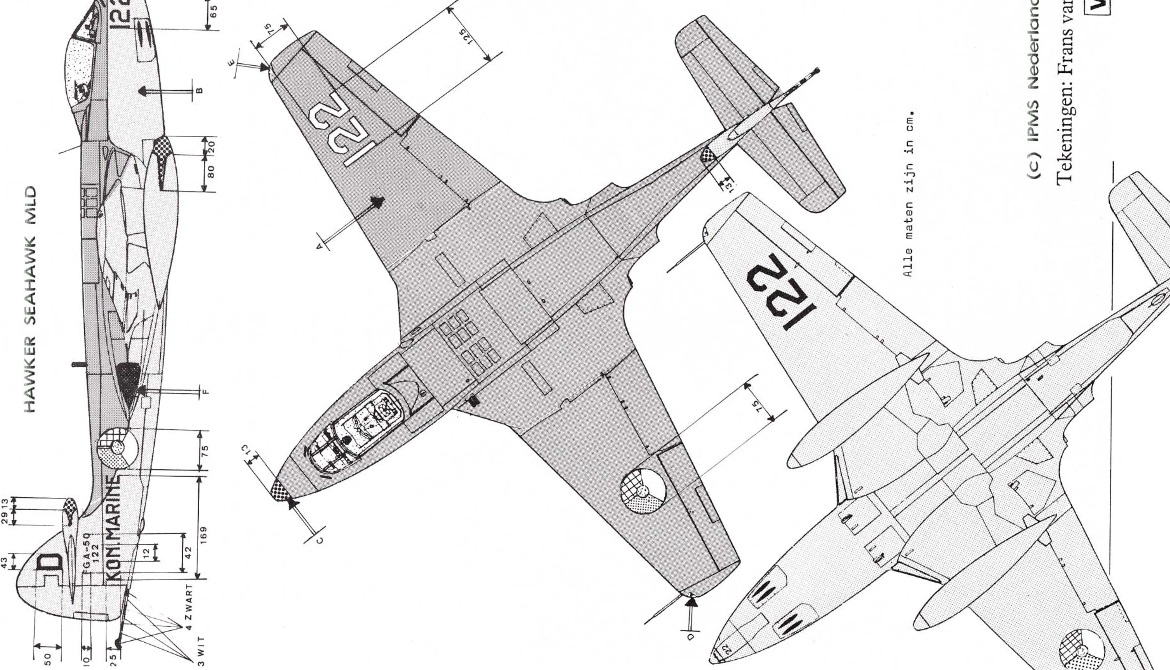
Also in 1956, 22 Sea Hawks were ordered by the Dutch to operate with the Naval Air Service (Marine Luchtvaartdienst - MLD)

Youtube Link
Also in 1956, 22 Sea Hawks were ordered by the Dutch to operate with the Naval Air Service (Marine Luchtvaartdienst - MLD)

Read more in Hawker Siddeley Aircraft was a British aircraft manufacturer.


.svg.png)