
Hawker Aircraft Limited
Hawker Typhoon
Introduction date 11 September 1941
First flight 24 February 1940
Number built 3,317
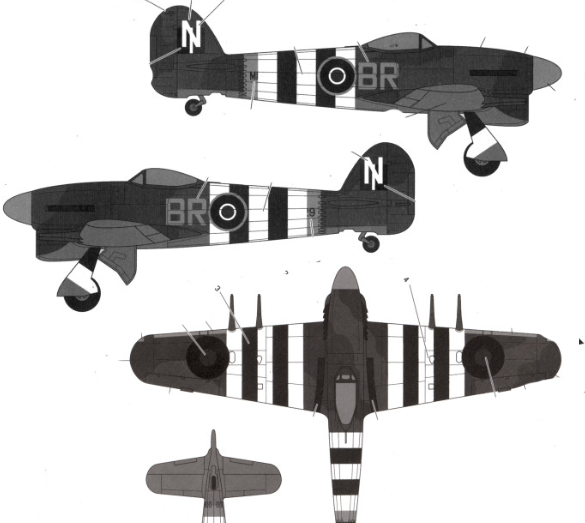

Hawker Aircraft Limited Hawker Typhoon
 |
|
| General information | |
|---|---|
| Type | Fighter-bomber |
| National origin | United Kingdom |
| Manufacturer | Hawker Aircraft |
| Designer | Sydney Camm |
| Built by | Gloster Aircraft Company |
| Primary users | Royal Air Force |
| Number built | 3,317 |
| History | |
| Manufactured | 1941–1945 |
| Introduction date | 11 September 1941 |
| First flight | 24 February 1940 |
| Retired | October 1945 |
| Developed into | Hawker Tempest |
|
|
|---|
.
History Hawker Aircraft Limited
Hawker Typhoon
Introduction date 11 September 1941 First flight 24 February 1940

The Hawker Typhoon was a British single-seat fighter-bomber, produced by Hawker Aircraft. It was intended to be a medium-high altitude interceptor, as a replacement for the Hawker Hurricane, but several design problems were encountered and it never completely satisfied this requirement. The Typhoon was originally designed to mount twelve .303 inch (7.7 mm) Browning machine guns and be powered by the latest 2,000 hp (1,500 kW) engines. Its service introduction in mid-1941 was plagued with problems and for several months the aircraft faced a doubtful future. When the Luftwaffe brought the new Focke-Wulf Fw 190 into service in 1941, the Typhoon was the only RAF fighter capable of catching it at low altitudes; as a result it secured a new role as a low-altitude interceptor
Design and development

Even as Hurricane production began in March 1937, Sydney Camm embarked on designing its successor. Camm had contacted the Air Ministry and asked what projects Hawker could consider, number two on their list was a single-engined fighter. Two preliminary designs were similar and larger than the Hurricane. These later became known as the "N" and "R" (from the initial of the engine manufacturers), because they were designed for the newly developed Napier Sabre and Rolls-Royce Vulture, engines respectively. Both engines used 24 cylinders and were designed for over 2,000 hp (1,500 kW); the difference between the two was primarily in the arrangement of the cylinders – an H-block in the Sabre, and an X-block in the Vulture. Hawker submitted these preliminary designs in July 1937, but were advised by the Director of Technical Development to wait until a formal specification for a new fighter to replace the Spitfire and Hurricane was issued. He also cautioned that while they liked the design, they did not think the wing would be stiff enough.
-
Modifications 1941–1945

As was usual with many front line Second World War RAF aircraft, the Typhoon was modified and updated regularly, so that a 1945 production example looked quite different from one built in 1941. In the last months of the war, a number of older aircraft were taken out of storage and overhauled, sometimes seeing active service for the first time; for example, R7771 was from one of the first production batches, built in 1942 with the car-door canopy and other early production features. This Typhoon was delivered to, and served on the Fighter Interception Unit in 1942. In February 1945 R7771 was listed as being in front line service on 182 Sqn.; by then it was fitted with a clear-view "bubble" hood, rocket rails and other late series features

0
KmCeiling
0
KmCombat RANGE
0
KM/hAircraft Speed
0
Max Crew




Hawker Siddeley Aircraft
Hawker Siddeley HS 748 (formerly Avro HS 748)
Manufactured 1961–1988, First flight 24 June 1960
General Info
-
-
-
- Crew: One
- Length: 31 ft 11.5 in (9.741 m)
- Wingspan: 41 ft 7 in (12.67 m)
- Height: 15 ft 4 in (4.67 m)
- Wing area: 279 sq ft (25.9 m2)
-
-
Powerplant
-
-
- Empty weight: 8,840 lb (4,010 kg)
- Gross weight: 11,400 lb (5,171 kg)
- Max takeoff weight: 13,250 lb (6,010 kg) with two 1,000 lb (450 kg) bombs
- Powerplant: 1 × Napier Sabre IIA, IIB or IIC H-24 liquid-cooled sleeve-valve piston engine, 2,180 hp (1,630 kW)
-
- Sabre IIB: 2,200 hp (1,600 kW)
-
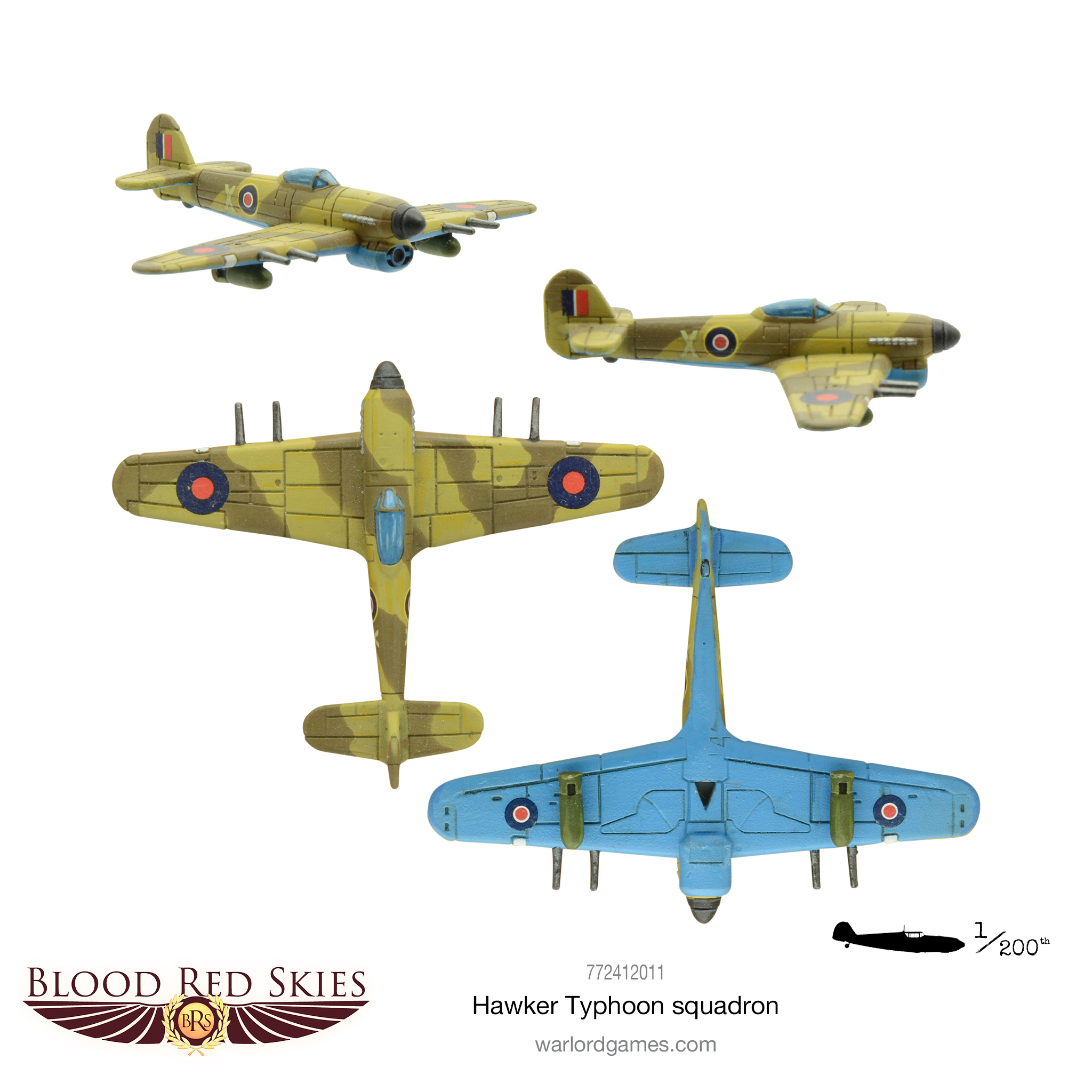
Performance
-
- Maximum speed: 422 mph (679 km/h, 367 kn) at 12,500 ft (3,800 m) with Sabre IIA & 4-bladed propeller
- Stall speed: 88 mph (142 km/h, 76 kn)
- Range: 510 mi (820 km, 440 nmi) with two 500 lb (230 kg) bombs; 690 mi (1,110 km) "clean"; 1,090 mi (1,750 km) with two 45 imp gal (200 L; 54 US gal) drop tanks.
- Service ceiling: 31,800 ft (9,700 m)
Armament
-
-
- Guns: 4 × 20 mm (0.787 in) Hispano Mk II cannon
- Rockets: 8 × RP-3 unguided air-to-ground rockets.
- Bombs: 2 × 500 lb (230 kg) or 2 × 1,000 lb (450 kg) bombs
-
Links to Youtube & Others
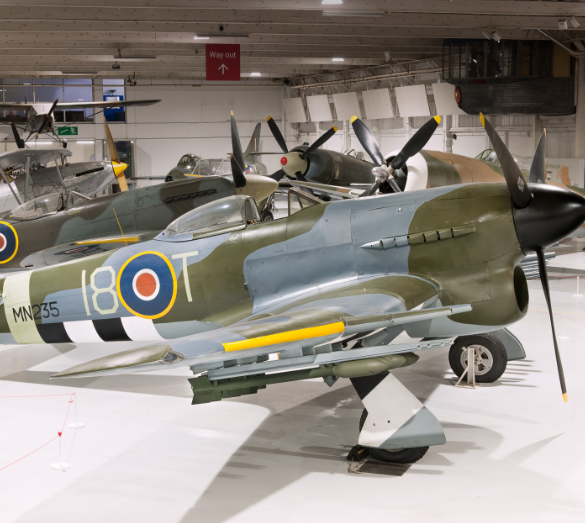
Only one complete Hawker Typhoon still survives: serial number MN235. Originally on display at the National Air and Space Museum (part of the Smithsonian Institution) in the United States, it was presented to the RAF Museum in Hendon

Hawker aircraft
Hawker Typhoon
Rather a large aircraft shall we say, for a single-engine fighter. Terrific power. Quite something to control.
Youtube Link
She roared, screamed, groaned and whined, but apart from being rather heavy on the controls at high speeds she came through her tests with flying colours

Read more in Hawker Siddeley Aircraft was a British aircraft manufacturer.



.svg.png)