Handley Page Limited
Successor Scottish Aviation
Handley Page H.P.42 and H.P.45
First flight 14 November 1930


Handley Page
H.P.42 and H.P.45
.jpg) |
|
| General information | |
|---|---|
| Type | Civilian airliner |
| Manufacturer | Handley Page |
| Designer | George Volkert and Harold Boultbee |
| Primary users | Imperial AirwaysRoyal Air Force |
| Number built | 4 HP.42, 4 HP.45 |
| History | |
| Introduction date | June 1931 |
| First flight | 14 November 1930 |
| Retired | 1940 (all lost) |
|
|
.
History Handley Page Limited
Successor Scottish Aviation
Handley Page H.P.42 and H.P.45
First flight 14 November 1930
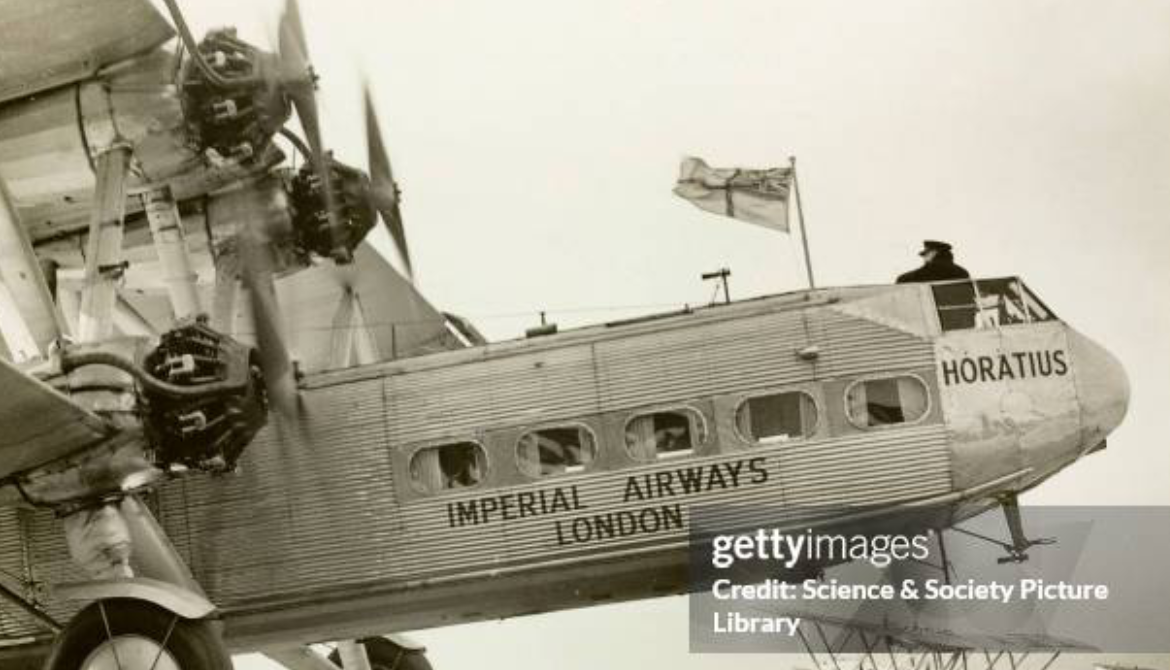
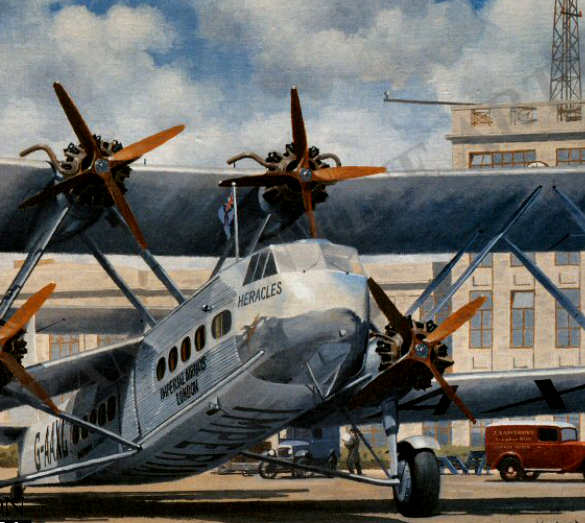
The Handley Page H.P.42 and H.P.45 were four-engine biplane airliners designed and manufactured by British aviation company Handley Page, based in Radlett, Hertfordshire. They held the distinction of being the largest airliners in regular use in the world on the type's introduction in 1931. The H.P.42/45 were designed in response to a specification issued during 1928 by the British flag airline Imperial Airways. The two models are very similar, with the H.P.42 optimised for range at the expense of payload while the H.P.45 carried more passengers over shorter distances. Imperial Airways approved Handley Page's proposals and ordered four aircraft of the two variants to serve as the new land-based long-distance flagships of its fleet.
The Handley Page H.P.42 was a large unequal-span sesquiplane. It incorporated numerous original features throughout its design. It had an all-metal frame with fabric covering on the wings, tail surfaces and rear fuselage. The fuselage comprises two sections, the unusually long forward section built up around massive riveted girders and partly skinned with corrugated metal, while the rear was built around welded steel tubes and skinned with fabric. Their construction was noted as being relatively expensive,
Development
Individual histories
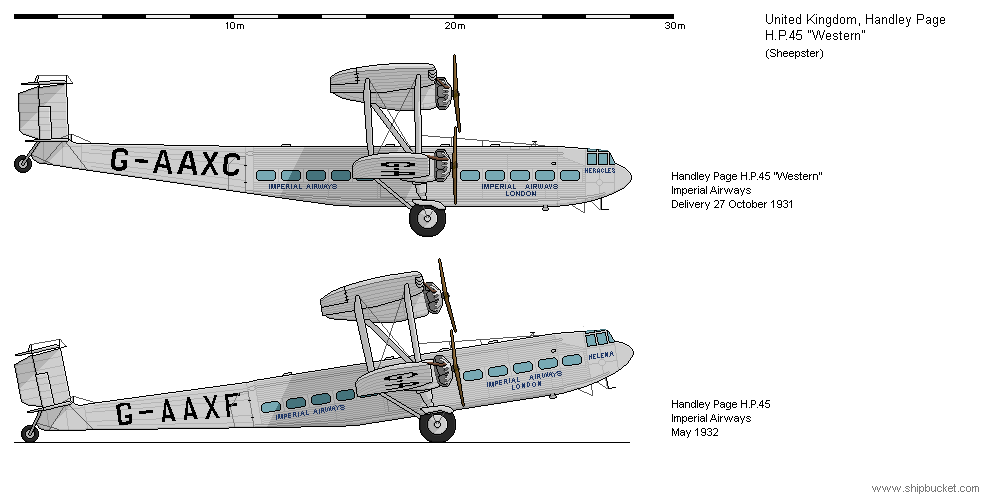
Four H.P.42 and four H.P.45 aircraft were delivered, while two of the H.P.45s were later converted into H.P.42s.
H.P.42
.jpg)
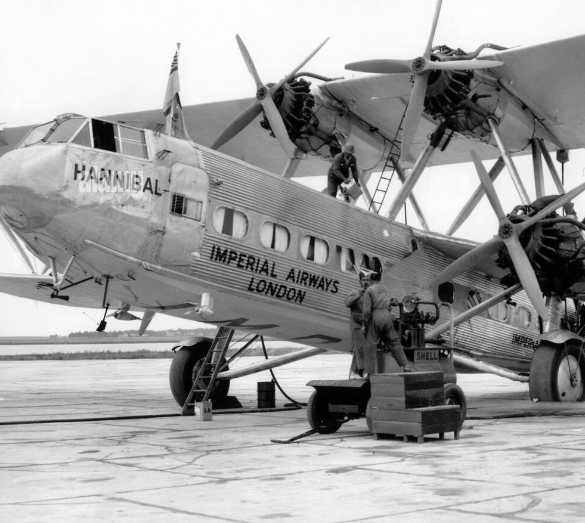
G-AAGX Hannibal
The first flight of the prototype, Hannibal, was on 14 November 1930. The aircraft was named after Hannibal, the Carthaginian military commander.
On 8 August 1931, while on a scheduled passenger flight from Croydon to Paris the port lower engine failed. Debris from the failed engine struck the port upper propeller, causing it to vibrate so severely it had to be shut down. A forced landing was made at Five Oak Green, Kent where the aircraft suffered further damage to a wing and another propeller, and the tail was ripped off by a tree stump. There were no major injuries amongst the 20 passengers and crew. The aircraft was dismantled and taken to Croydon by road for rebuild. Hannibal was again damaged at the RAF temporary landing ground at Semakh on the Sea of Galilee on 17 November 1932, by strong winds. The fuselage and heavily damaged wings were sent by 3 ft 5 in (1.05 m) gauge Hedjaz Railway to Haifa, where it was transferred to the 1.435 m (4 ft 8.5 in) standard gauge Palestine Railways and forwarded to Heliopolis for repair. It disappeared over the Gulf of Oman on 1 March 1940, with eight aboard, including the First World War ace Group Captain Harold Whistler and the Indian politician Sir A. T. Pannirselvam. An early report that wreckage of the aircraft had been located, turned out to be incorrect. No trace has ever been discovered and the cause of its loss remains unknown
0
KmCeiling
0
KmCombat RANGE
0
Km/hAircraft Speed
0
Max Crew
Photo Gallery
Handley Page Limited
Successor Scottish Aviation
Handley Page H.P.42 and H.P.45
First flight 14 November 1930




Handley Page Limited
Successor Scottish Aviation
Handley Page H.P.42 and H.P.45
First flight 14 November 1930
General Info
-
-
- Crew: 4
- Capacity: 24 passengers and 14.2 cu m mail/baggage
- Length: 92 ft 2 in (28.09 m)
- Wingspan: 130 ft 0 in (39.62 m)
- Height: 27 ft 0 in (8.23 m)
-
Powerplant
-
-
- Empty weight: 17,740 lb (8,047 kg)
- Max takeoff weight: 28,000 lb (12,701 kg)
- Powerplant: 4 × Bristol Jupiter XIF 9-cylinder air-cooled radial piston engines, 490 hp (370 kW) each
- Propellers: 4-bladed fixed-pitch wooden propellers
-
Performance
- Maximum speed: 120 mph (190 km/h, 100 kn)
- Cruise speed: 100 mph 160 km/h,
- Range: 500 mi (800 km, 430 nmi)
- Rate of climb: 790 ft/min (4.0 m/s)
Aircraft of
comparable role
Links to Youtube & Others
Replica Several efforts have been made to produce an H.P.42 for heritage/preservation purposes. During 2015, a fundraising campaign was launched with the aim of producing a replica of the H.P.42. Original blueprints and other source material from the era are available and while a replica can be built to be airworthy, modern safety regulations prevent carrying paying passengers

Handley Page
H.P.42 and H.P.45
In 1956, Vickers had performed a series of low level tests in WZ383 to assess the type for low level flight at high speed.
Youtube Link
The H.P.42 was powered by four 490 hp (370 kW) Bristol Jupiter XIFs, while the H.P.45 variant used four 555 hp (414 kW) Jupiter XFBM supercharged engines
Read more in
Handley Page Limited
Successor Scottish Aviation
.


.png)
.png)